Author: Site Editor Publish Time: 2026-07-02 Origin: Site
Unplanned power outages are not just operational inconveniences. They present immediate, measurable financial and reputational risks to your organization. Every minute your facility stays dark, you lose revenue, compromise critical data, and damage client trust. Procuring a commercial backup power system is a major capital decision. It bridges the gap between daily facility management and high-level executive risk mitigation.
You need a reliable solution designed precisely for your operational demands. Basic functionality is no longer enough to protect modern enterprises. This guide moves beyond simple technical specs. We provide a strict, compliance-aware framework for evaluating, sizing, and selecting the right system for your facility. You will learn how to navigate fuel options, regulatory codes, and integration requirements. This ensures your investment delivers seamless resilience when the grid fails.
Effective selection starts with a Business Impact Analysis (BIA) to separate critical operational loads from non-essential power draws.
Fuel type selection (Diesel vs. Natural Gas) dictates not only upfront costs but ongoing compliance, maintenance regimens, and operational resilience.
Total Cost of Ownership (TCO) heavily skews toward lifecycle maintenance, testing, and fuel management, not just initial hardware CapEx.
Integration with smart control systems and Automatic Transfer Switches (ATS) is mandatory for seamless business continuity.
You cannot effectively protect a facility until you understand its vulnerabilities. Building a resilient strategy requires evaluating exactly how downtime impacts different departments. When exploring a commercial backup power generator, you must map these priorities meticulously.
A Business Impact Analysis (BIA) forms the foundation of any robust continuity plan. It maps downtime tolerance to specific business units. For example, a data center cannot tolerate even a millisecond of power loss. Conversely, back-office HVAC systems might remain offline for an hour before temperatures reach critical levels. By quantifying these thresholds, you prevent expensive over-specification.
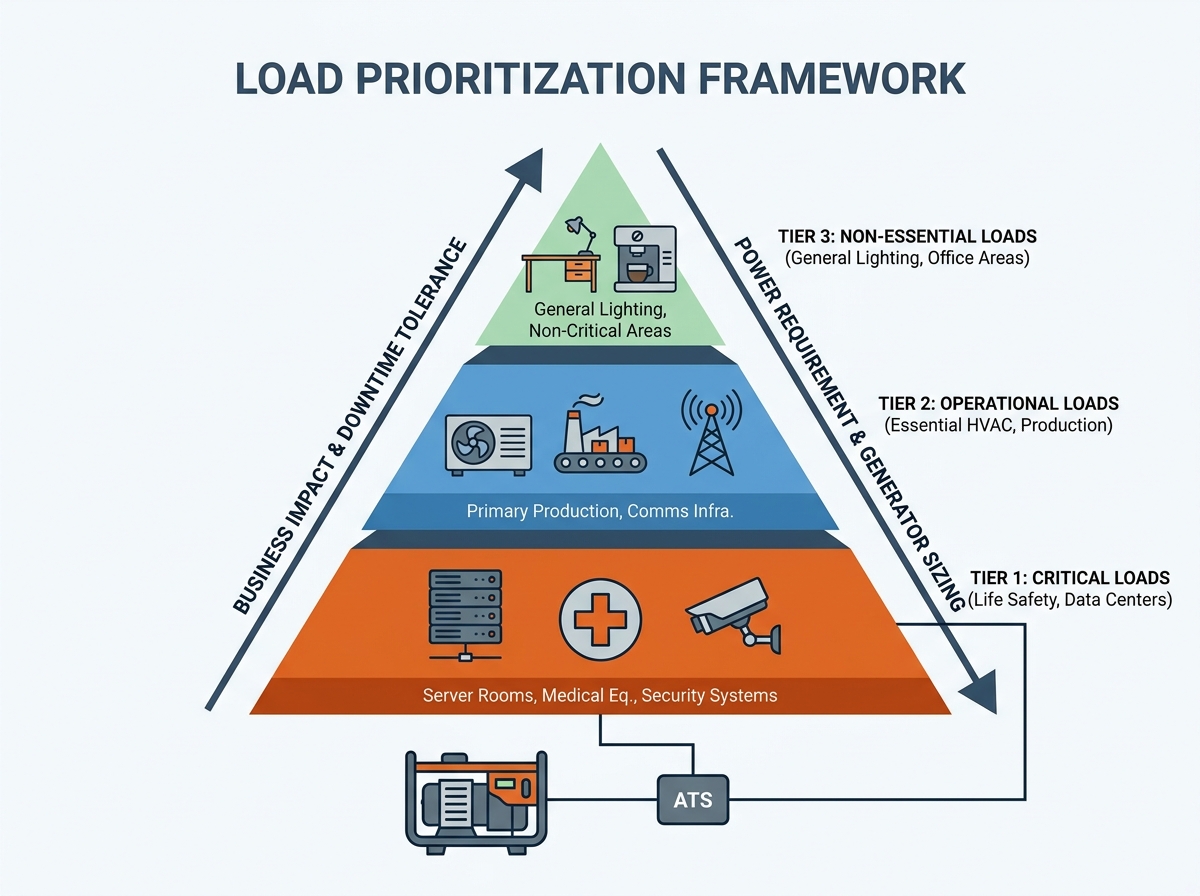
Facilities rarely need to back up 100% of their standard electrical load. Segmenting your power requirements ensures emergency systems support truly vital operations first. We recommend organizing loads into three distinct categories:
Tier 1 (Life Safety & Critical): Security systems, emergency lighting, server rooms, and medical life-support equipment. Code mandates these systems receive power within 10 seconds of an outage.
Tier 2 (Operational): Essential HVAC units, primary production lines, and core communications infrastructure. These keep your business running but do not represent immediate life safety concerns.
Tier 3 (Non-Essential): General area lighting, cafeteria equipment, and non-critical office zones. You typically drop these loads during emergency operations to conserve fuel and generator capacity.
Define exact uptime requirements before you engage vendors. Many enterprise facilities require N+1 redundancy. This means you have at least one independent backup module standing by if a primary unit fails. Establishing these baseline parameters ensures you source a system perfectly tuned to your risk profile.
Best Practice: Always involve IT, operations, and facility management teams when drafting success criteria. Siloed planning often leaves crucial network infrastructure unprotected.
Fuel selection drives your maintenance routines, site footprint, and regulatory obligations. You must weigh the logistical realities of your geographic location against the technical capabilities of different engine types.
Diesel engines remain the backbone of commercial emergency power. They offer unmatched reliability for heavy-duty applications.
Pros: Diesel provides the highest energy density available. These units offer rapid response times, handling massive block loads instantly. Under heavy loads, diesel engines boast incredibly long lifespans.
Cons and Risks: They face strict EPA emission regulations. If you run a diesel engine under low loads, you risk "wet-stacking," where unburned fuel builds up in the exhaust. They also require proactive fuel polishing and chemical treatments to prevent microbial degradation over time.
Natural gas systems are highly effective backup generator solutions for commercial buildings operating in dense urban environments.
Pros: They connect directly to municipal pipelines, providing a virtually infinite fuel supply. They produce significantly lower emissions and bypass the complex compliance hurdles associated with on-site liquid fuel storage.
Cons and Risks: They depend entirely on local utility infrastructure. Seismic events or severe weather can trigger pipeline shutoffs, leaving you without fuel. They also feature lower power density, meaning a natural gas unit requires a larger physical footprint to match the output of a comparable diesel engine.
Bi-fuel systems blend diesel and natural gas. They provide balanced flexibility for facilities facing stringent emission constraints but requiring off-grid reliability. Propane generators serve niche applications well. Propane does not degrade over time like diesel, making it ideal for remote telecom towers or isolated emergency clinics.
Feature | Diesel | Natural Gas | Propane |
|---|---|---|---|
Energy Density | Very High | Moderate | Moderate to High |
Fuel Storage | On-site tanks (requires maintenance) | Municipal pipeline (no storage) | On-site pressurized tanks |
Emissions | High (requires strict permitting) | Low (easier compliance) | Moderate |
Grid Independence | 100% Independent | Dependent on utility pipelines | 100% Independent |
Specifying the right equipment requires deep electrical engineering insights. Guesswork here leads to catastrophic failures during active emergencies.
Never rely on simple square-footage calculators. Commercial equipment sizing requires professional load bank profiling. Engineers must analyze both starting (surge) and running kilowatt requirements. Heavy motor loads, like industrial chillers or manufacturing presses, demand massive inrush currents to start. If your generator only accounts for running loads, the starting surge will stall the engine.
Common Mistake: Failing to account for harmonic distortion from Uninterruptible Power Supplies (UPS). Nonlinear loads can severely disrupt a generator's voltage regulator if not sized properly.
The ATS acts as the brain of your emergency power architecture. It monitors utility voltage 24/7. When power fails, the ATS signals the generator to start and safely transfers the building load.
Open Transition: This is a "break-before-make" switch. It briefly disconnects the facility from all power before connecting to the generator. You will experience a momentary flicker.
Closed Transition: This is a "make-before-break" switch. During planned testing or utility restoration, it temporarily overlaps the generator and grid power. This prevents any disruption to sensitive equipment. Facilities with zero downtime tolerance heavily rely on closed transition models.
Modern enterprise oversight requires complete visibility. You must integrate smart monitoring systems to track performance remotely. These systems automate weekly exercise logging, monitor fuel levels, and send predictive maintenance alerts directly to facility managers. Real-time diagnostics prevent minor faults from evolving into major failures during a crisis.
Purchasing the hardware is only the first step. Installing a heavy-duty power system involves navigating a labyrinth of local, state, and federal regulations.
Strict codes govern emergency power deployment. The National Electrical Code (NEC) dictates exact wiring methodologies and separation requirements for emergency life-safety circuits. Additionally, you must adhere to NFPA 110 standards. This framework outlines the required performance, testing, and maintenance intervals for emergency power supply systems. Non-compliance often results in failed facility inspections and severe fines.
Municipalities rigorously enforce environmental impacts. You must evaluate acoustic enclosure ratings to meet local noise ordinances. Manufacturers measure sound attenuation in decibels (dBA) at the property line. Furthermore, local air quality districts regulate exhaust emissions. Non-emergency usage, such as peak shaving or grid-demand response programs, typically requires stringent EPA Tier 4 Final emission certifications.
Assess physical constraints early in the planning phase. Rooftop installations require structural load-bearing analysis. Generators cause intense vibrations and weigh thousands of pounds. Ground-level installations need adequate clearance for maintenance access and fueling trucks. You must also maintain strict setbacks from windows and intake vents to safely dissipate exhaust gases.
Your relationship with a vendor extends far beyond the initial installation. Choosing the right partner ensures your equipment remains operational for decades.
Selecting a dealership requires scrutinizing their operational capabilities. Follow this framework when assessing potential partners:
Service Network Density: Prioritize vendors maintaining local, robust technician networks. They must offer 24/7 dispatch capabilities. Demand guaranteed Service Level Agreement (SLA) response times for emergency outages.
Parts Availability and Supply Chain: Question their supply chain resilience. Determine if they stock critical Original Equipment Manufacturer (OEM) replacement parts locally. Heavy reliance on aftermarket parts or distant warehouses extends downtime significantly.
Warranty Structures: Analyze the depth of the warranty over the expected equipment lifespan. Differentiate between comprehensive coverage (parts, labor, and travel) and limited warranties that only replace defective hardware.
If you require highly customized commercial backup power generator configurations, partner with organizations demonstrating extensive engineering support. A reliable dealership acts as an extension of your facility management team, guiding you through lifecycle testing and preventive maintenance schedules.
A robust commercial power system acts as a crucial risk mitigation asset. It protects your revenue, secures sensitive data, and ensures employee safety during unpredictable grid failures. Success requires rigorous upfront alignment with your business continuity goals.
Remember these key actions:
Always conduct a thorough BIA to prioritize critical loads accurately.
Select a fuel type aligned with your geographical constraints and regulatory environment.
Look beyond basic sizing tools; demand professional load profiling.
Partner with a vendor offering robust 24/7 support and comprehensive warranties.
Your next step should be proactive. Initiate a professional site audit and electrical load study before drafting formal vendor Requests for Proposals (RFPs). This ensures you gather accurate data to design a truly resilient facility.
A: A complete installation typically takes between 3 to 9 months. This timeline accounts for site engineering, permitting processes, manufacturing lead times, and physical construction. Custom configurations or complex zoning approvals can push this timeline past 12 months.
A: When properly maintained, these systems easily last 20 to 30 years. Industry benchmarks measure lifespan in operating hours, generally ranging from 15,000 to 30,000 hours. Strict adherence to scheduled maintenance and regular load bank testing maximizes this longevity.
A: Theoretically, they can run as long as the municipal gas supply remains active. However, all engines require periodic shutdowns for mechanical maintenance, such as oil changes and filter replacements, typically every 100 to 200 hours of continuous operation.
A: Wet-stacking occurs when a diesel engine runs under light loads, failing to reach optimal operating temperatures. Unburned fuel and carbon accumulate in the exhaust system, degrading performance. You prevent this by performing routine load bank testing to burn off the deposits.