Author: Site Editor Publish Time: 2026-06-26 Origin: Site
The global power grid faces unprecedented instability from extreme weather and surging energy demands. Facility leaders can no longer view backup power as a nice-to-have insurance policy. Today, it stands as an absolute baseline requirement for commercial operational continuity.
Unplanned downtime in a commercial facility does not simply halt your daily productivity. It immediately triggers severe life safety compliance violations, destroys sensitive data, and drives compounding financial deficits. When the lights go out, buildings lacking proper safeguards face massive operational liabilities.
This guide aims to push past basic definitions and outline real-world power strategies. We will equip facility managers and building owners using an evidence-based operational framework. Read on to learn how to expertly evaluate, size, and implement reliable commercial power systems.
Commercial generators are specialized, high-capacity systems requiring complex integration with a building's existing electrical infrastructure and Automatic Transfer Switches (ATS).
Selection hinges on an empirical load calculation (peak vs. continuous) rather than square footage estimates.
Fuel type selection (Diesel vs. Natural Gas vs. Bi-Fuel) dictates not only upfront costs but long-term regulatory compliance, maintenance protocols, and site footprint.
True ROI is measured through risk mitigation: avoiding code violations, preventing inventory/data loss, and ensuring life safety system continuity during extended outages.
You must understand the distinct differences between basic residential units and industrial-grade equipment. Residential models handle minor loads for brief periods. A robust commercial unit outputs stable three-phase power. Capacities easily scale from 50 kW up to multi-megawatt installations. They feature heavy-duty liquid cooling systems designed to handle sustained operational loads during prolonged blackouts.
These complex machines consist of several interconnected subsystems working perfectly together. We can break down the core components into three main categories:
The Engine and Alternator: This forms the heart of the power generation process. The engine consumes fuel to create mechanical energy. The alternator then converts this mechanical motion into usable electrical current.
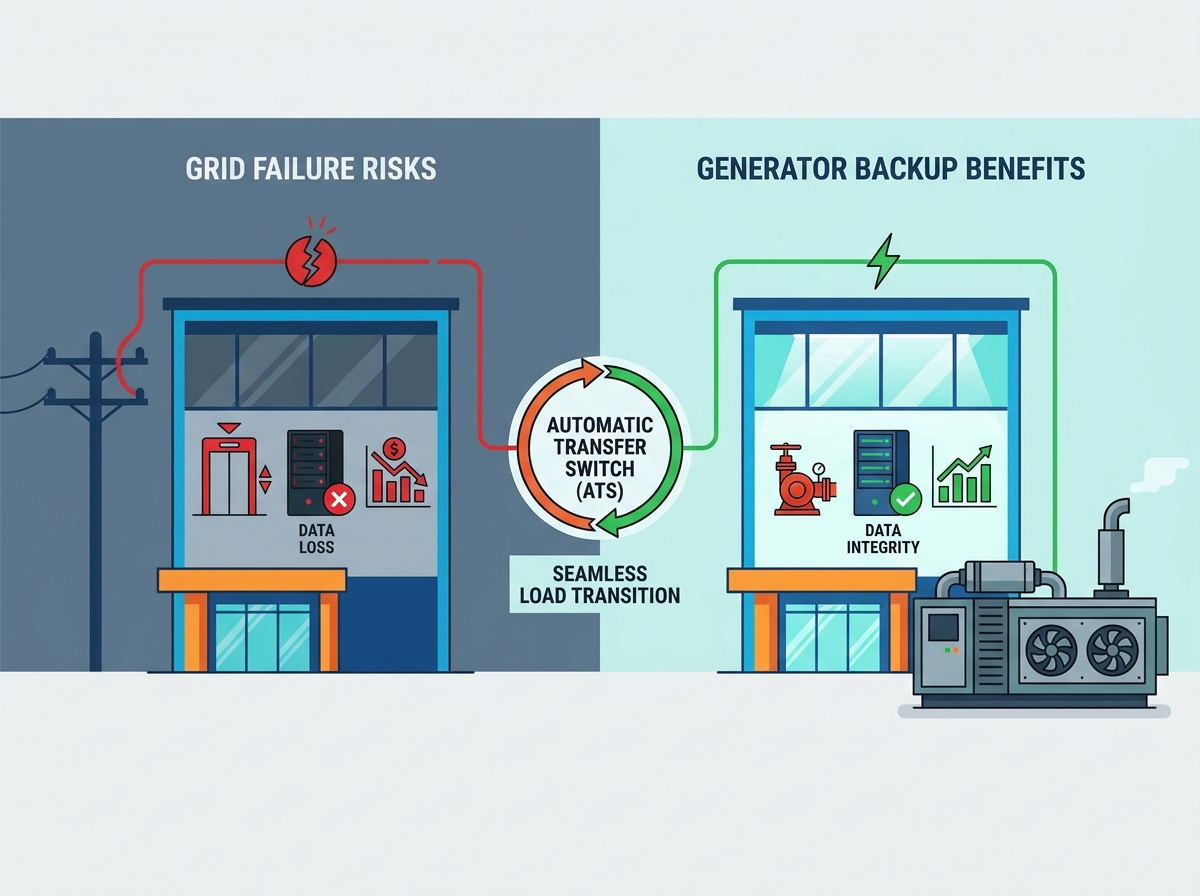
Automatic Transfer Switch (ATS): The ATS serves as the brain directing electrical traffic. It continuously monitors utility power quality. Once it detects a drop, the ATS commands the generator to start. It then seamlessly transitions the building load onto backup power.
Control Panels: These digital interfaces offer deep system diagnostics. Operators use them to monitor engine health and execute paralleling capabilities. They also enable remote monitoring for off-site facility teams.
Many people mistakenly treat a commercial unit as a plug-and-play appliance. The integration reality demands a highly engineered infrastructure upgrade. Installation requires precise voltage matching. Technicians must ensure strict phase alignment between the municipal grid and your onsite hardware. A misaligned phase can destroy sensitive facility electronics instantly. Proper integration protects your entire electrical topology.
Facility managers invest in backup power to ensure strict life safety and code compliance. Building codes mandate specific systems remain active during emergencies. Emergency lighting, fire suppression pumps, and elevator systems must receive continuous electricity. The National Fire Protection Association outlines these rules heavily in NFPA 101 (Life Safety Code). Local municipal boards often enforce even stricter regional mandates. Failing to meet these codes invites severe legal exposure.
Financial and operational risk mitigation provides the second driving factor. You can easily quantify the true cost of downtime. A data center losing its HVAC systems faces immediate server meltdown. A cold storage warehouse experiences catastrophic inventory spoilage within hours. Manufacturing lines halt completely, missing tight delivery deadlines. We view this infrastructure investment as a hard hedge against calculable revenue loss. You protect your bottom line by guaranteeing uptime.
We also see growing opportunities around grid instability and demand response. Utility companies struggle to meet peak summer and winter loads. Facilities generating their own electricity hold a unique strategic advantage. You can voluntarily take your building off the main grid during peak strain hours. This participation in utility demand response programs often yields substantial financial rebates. It transforms your backup asset into an active revenue generator.
Choosing the correct fuel source fundamentally changes how your facility operates during an outage. Each category presents unique strengths and implementation challenges. As you select commercial backup power generators for buildings, carefully weigh these operational profiles against your site restrictions.
Diesel systems remain the historic industry standard. They offer the highest energy density available. The engines provide an incredibly rapid response time when utility power fails. Additionally, diesel hardware benefits from deeply established maintenance and parts networks nationwide.
However, implementation carries several notable risks. Facilities face strict onsite fuel storage regulations. You must install complex spill containment basins. Diesel fuel degrades naturally over time. Facility managers must schedule regular fuel polishing to remove sludge and moisture. Finally, diesel engines must meet stringent EPA emissions standards, often requiring complex exhaust aftertreatment systems.
A natural gas commercial backup power generator solves many fuel storage headaches. The local utility pipes fuel directly to your site. This delivers a continuous fuel supply without requiring bulky onsite tanks. These engines also emit fewer pollutants, creating a much cleaner burning process.
You must consider the specific vulnerability of underground infrastructure. Pipeline disruptions can occur during severe seismic events or extreme winter freezes. Furthermore, natural gas carries a lower power density compared to diesel. This reality requires physically larger engine units to produce the exact same electrical output.
Bi-fuel systems blend the best traits of multiple fuel types. They typically start on diesel and seamlessly transition to a mix incorporating natural gas. This strategy combines natural gas availability alongside trusted diesel reliability. It dramatically extends emergency runtimes when resupply trucks cannot reach your site.
The primary drawbacks involve increased mechanical complexity. Combining two fuel delivery systems introduces more moving parts. Your maintenance team will need specialized training to service the injection manifolds properly. Despite the complexity, hybrids offer unparalleled redundancy for critical facilities.
Fuel Category | Primary Strengths | Implementation Risks | Best Use Case |
|---|---|---|---|
Diesel | High energy density; rapid startup; robust support network. | Strict fuel storage rules; fuel degrades; higher emissions. | Standby life-safety loads; remote industrial sites. |
Natural Gas | Continuous pipeline supply; cleaner emissions; no fuel polishing. | Vulnerable to pipe fractures; requires larger footprint per kW. | Urban commercial centers; facilities lacking tank space. |
Bi-Fuel | Extended runtimes; dual-fuel redundancy; fuel flexibility. | Complex mechanical servicing; specialized technician requirements. | Hospitals; large data centers; critical infrastructure. |
Accurate sizing prevents catastrophic system failure during an actual emergency. Never rely on broad "rule of thumb" square footage estimates. Facility owners must advocate for comprehensive electrical audits. This audit determines essential versus non-essential loads. You must calculate starting kVA meticulously. Large motors, such as elevator drives and HVAC chillers, demand a massive surge of current to start. Your unit requires adequate step-loading capabilities to handle these sudden power spikes sequentially.
You must carefully navigate spatial and acoustic compliance codes. Integration demands thorough site planning before pouring any concrete.
Footprint Planning: Municipalities enforce strict setbacks from property lines. Engineers must calculate safe exhaust clearances to prevent carbon monoxide pooling. They also evaluate structural support differences between rooftop and ground-level mounting.
Acoustic Treatments: City noise ordinances strictly govern operational decibel levels. You often need custom sound-attenuated enclosures. These heavy metal housings absorb mechanical noise, ensuring your facility remains compliant during midnight test runs.
Vibration Isolation: Heavy engines create intense physical shaking. Installers use spring isolators and rubber mounting pads. These prevent destructive vibrations from transferring into the building's structural foundation.
Scalability remains a crucial integration factor. Smart planners structure the initial deployment to allow for future generator paralleling. Paralleling links multiple smaller units together on a shared digital bus. You can easily add more units as facility power demands grow over the years. This modular approach beats replacing a prematurely undersized machine entirely.
Installing the hardware represents only the first step. Ongoing operational readiness depends entirely on rigorous maintenance protocols. Facility teams must execute continuous fluid analysis. Technicians regularly draw oil and coolant samples to spot microscopic engine wear. Routine battery testing proves critical. Dead starter batteries cause the vast majority of emergency startup failures. You must also conduct detailed moving parts inspections to catch fraying belts and loose alternator connections.
Regulatory bodies enforce strict testing mandates to ensure life safety. NFPA 110 dictates comprehensive operational guidelines. Facilities must perform monthly routine testing. The engine should run under at least a 30% load. This prevents a damaging condition known as "wet stacking" inside diesel engines. Wet stacking occurs when unburned fuel accumulates in the exhaust system due to light engine loads.
Beyond monthly checks, you must conduct an annual load bank test. A load bank acts as an artificial electrical draw. It forces the generator to run at its maximum rated capacity for several hours. This simulated full-load test burns off carbon deposits. It definitively verifies system readiness, ensuring the engine can handle a true facility-wide blackout without stalling.
Procuring heavy electrical infrastructure requires a disciplined approach. Begin by applying strict shortlisting logic to potential vendors. Do not evaluate providers solely on hardware specifications. You must assess their post-sale Service Level Agreements (SLA). Verify their regional parts availability. Ensure they offer localized engineering support. A robust machine holds little value if you cannot secure a certified technician during a regional blackout.
Next, you must commission a professional site survey. We urge readers to complete an exhaustive electrical load analysis before ever requesting hardware quotes. Bring in a licensed electrical engineer. They will map your existing breaker panels. They evaluate your current utility service entrance. This audit guarantees you request quotes for the exact capacity and phase configuration your building actually requires.
Finally, set realistic expectations regarding project timelines. Deploying a commercial backup power generator involves numerous administrative and logistical hurdles. Air quality boards and local zoning commissions take weeks to approve complex permits. Supply chain lead times on high-capacity transfer switches frequently stretch into months. You must also factor in final commissioning tests and municipal inspections before the system goes fully live.
Deploying commercial backup power serves as a critical infrastructure decision. It firmly bridges your daily operational security with strict life safety compliance. To move forward effectively, keep these final action steps in mind:
Abandon square-footage guessing and commission an empirical electrical load audit.
Select your fuel type based on site restrictions, emissions codes, and local supply reliability.
Design your installation footprint to account for noise ordinances and future paralleling expansion.
Commit to NFPA 110 testing standards to prevent wet stacking and verify maximum load readiness.
Consult a licensed integration engineer to seamlessly map your specific facility risks to the correct hardware profile.
A: A well-maintained commercial unit typically lasts between 20 to 30 years. In terms of operational usage, diesel engines reliably run for 10,000 to 30,000 hours before requiring a major overhaul. Reaching this upper limit assumes strict, documented adherence to routine maintenance, fluid analysis, and scheduled load bank testing protocols.
A: An Automatic Transfer Switch generally restores power within a 10-to-30-second window. The ATS senses the utility failure, signals the engine to crank, and waits for voltage stabilization. Once the alternator produces clean power, the ATS throws the mechanical contactor. This short duration easily meets standard life safety code requirements.
A: Yes. Installation requires navigating a complex intersection of local approvals. You need electrical permits for the wiring and ATS integration. Zoning boards must approve the physical footprint and acoustic treatments. Finally, environmental agencies often require air quality permits to monitor engine exhaust emissions and fuel tank spill containment.
A: No. You face limits based on fuel resupply logistics and engine ratings. Standby-rated generators must eventually shut down for routine oil and filter changes (often every 200 to 500 hours). Continuous-rated units run longer but still require mechanical servicing. Your ultimate limit always depends on maintaining a steady fuel delivery chain.