Author: Site Editor Publish Time: 2026-07-05 Origin: Site
Power loss at a commercial facility creates immediate, cascading crises. Revenue stops flowing, safety risks multiply rapidly, and sensitive data faces severe corruption. Choosing the right commercial backup power generator directly shields your operations from these catastrophic outcomes. Historically, facility managers only debated equipment horsepower. Today, the conversation involves much more complexity. You must balance strict emissions regulations against severe weather resilience and tight footprint constraints. Making the wrong choice can lead to failed code compliance or stranded assets during grid failures. This guide provides an objective, evidence-based framework. We evaluate both diesel and natural gas fuel types. You will discover how they align against your specific operational demands. We break down compliance realities, physical space limits, and municipal infrastructure reliability. By the end, you will understand exactly which technology matches your facility profile.
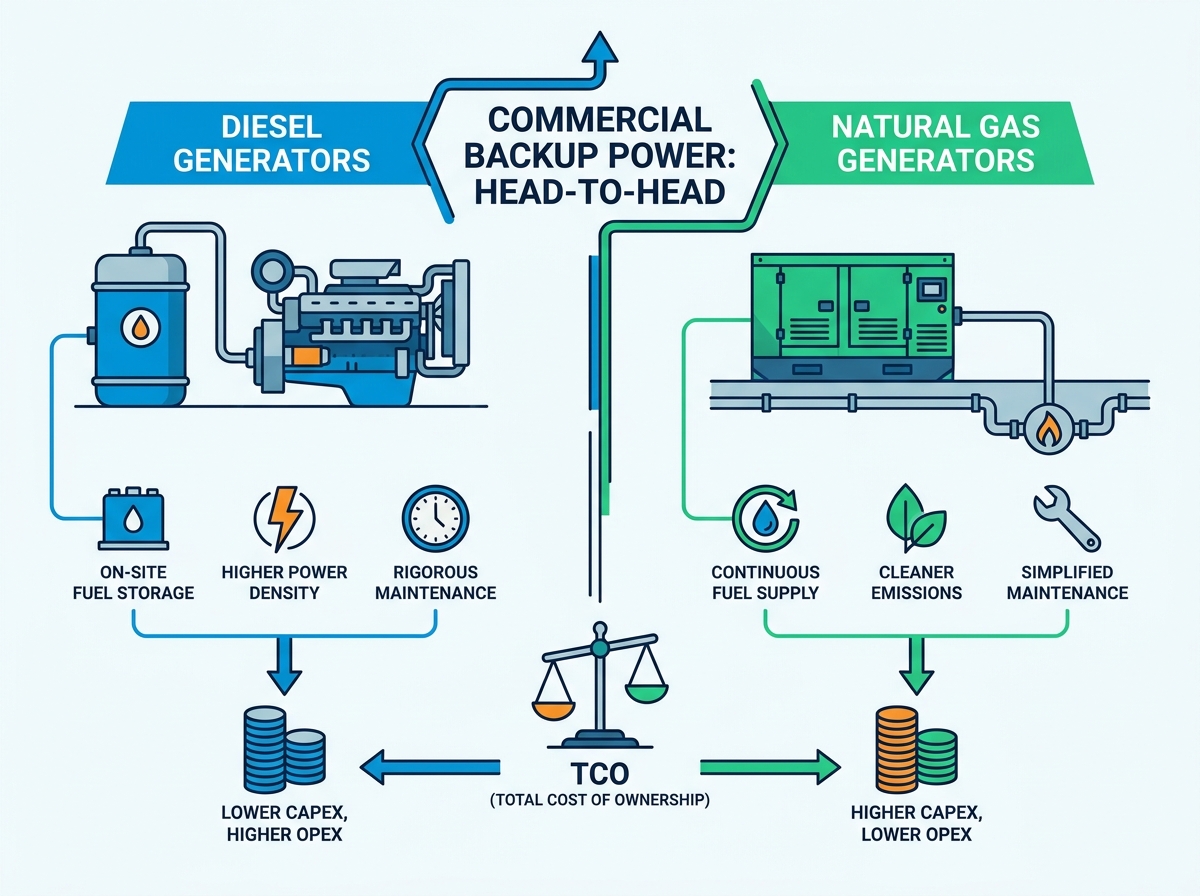
Diesel remains the industry standard for high-demand, standalone reliability and rapid response, but requires rigorous fuel maintenance and faces strict emission limits.
Natural Gas offers effectively unlimited runtime without on-site fuel storage and simplifies environmental compliance, but is vulnerable to municipal pipeline disruptions.
The Decision Driver: Your choice will ultimately hinge on local building codes, NFPA 110 requirements, available physical footprint, and specific natural disaster risks in your region.
Defining success for emergency power goes far beyond simply keeping the lights on. A resilient facility demands absolute uptime during unexpected utility failures. It requires strict compliance with local life-safety codes. It also demands manageable operational overhead. You cannot evaluate a generator solely on raw power output. You must examine it through multiple environmental and structural lenses.
Life-safety regulations heavily influence this equipment choice. The National Fire Protection Association (NFPA) establishes rigorous guidelines. NFPA 110 specifically governs emergency and standby power systems. These life-safety requirements often dictate on-site fuel storage minimums. Hospitals and mission-critical facilities must typically store enough fuel for 24 to 96 hours of continuous operation. Historically, this strict mandate heavily favored diesel engines. They allow straightforward on-site liquid storage.
Physical footprint constraints introduce another major hurdle. Commercial real estate often lacks abundant spare space. Roof loading limits restrict heavy equipment placement. Engineers must calculate structural capacities carefully. Fuel tank spacing codes dictate strict distance requirements. You must keep flammable storage far away from building entrances and property lines. Underground storage tanks introduce severe environmental risks and leak liabilities. You must weigh these site realities before selecting a fuel type.
Backup Power Evaluation Criteria
Evaluation Criteria | Diesel Engine Considerations | Natural Gas Engine Considerations |
|---|---|---|
Life-Safety Compliance | Easily meets strict on-site fuel storage mandates. | Often requires special municipal waivers or dual-fuel setups. |
Physical Footprint | Requires substantial ground space for bulky fuel tanks. | Highly compact footprint utilizing existing pipeline infrastructure. |
Environmental Impact | Faces strict EPA Tier 4 emissions and noise regulations. | Offers a highly favorable low-emission and low-noise profile. |
Disaster Resilience | Immune to utility pipeline breaks but vulnerable to road closures. | Immune to road closures but vulnerable to seismic pipeline breaks. |
Best Practice: Always engage a structural engineer early. They will evaluate your concrete pads or roof joists before you commit to heavy on-site fuel tanks.
Common Mistake: Many facility managers ignore local noise ordinances. They install large engines near property lines and fail subsequent municipal noise inspections.
Diesel engines have dominated the industrial sector for decades. They remain the default choice for heavy-duty applications. Their fundamental design delivers massive energy density. They produce high torque instantly. This enables an extremely fast transient response. When the grid drops, diesel units assume the massive electrical load in seconds. They prevent voltage dips across sensitive commercial networks.
These systems deliver distinct operational advantages. First, they provide true standalone independence. They do not rely on public utilities during catastrophic events. Earthquakes or widespread freezes often sever underground utility lines. A filled diesel tank guarantees operational continuity. Second, they offer superior power density. They require a much smaller engine footprint per kilowatt generated. Finally, these engines boast incredible lifespan and durability. Engineers design them specifically for heavy, sudden loads.
However, diesel technology carries significant implementation risks. You must consider the skeptical view. Fuel degradation presents a constant, silent challenge. Modern ultra-low sulfur diesel has a realistic shelf life of just 6 to 12 months. It requires active fuel polishing. Technicians must circulate the fuel through centrifuges to remove water. You must add biocide treatments to prevent microbial sludge.
Another major risk involves wet stacking. Operators must run these engines under a heavy load. Light loads prevent the engine from reaching optimal operating temperatures. This causes unburned fuel and thick carbon to build up in the exhaust system. It destroys engine efficiency over time. Compliance hurdles also complicate deployment. The Environmental Protection Agency (EPA) enforces strict Tier 4 emission standards. These rules force facilities to install complex exhaust aftertreatment systems. Local jurisdictions often add severe spill containment mandates.
Fuel Maintenance Need: Quarterly testing and bi-annual chemical treatments.
Testing Requirement: Monthly load bank testing to burn off carbon deposits.
Spill Prevention: Double-walled tanks and concrete containment basins.
Municipal utility pipelines have grown significantly more robust over the last decade. Simultaneously, clean air regulations have tightened globally. These structural shifts drive the rising adoption of spark-ignited units. Today, natural gas emergency generators for commercial buildings represent a highly capable mainstream solution.
The advantages directly address modern facility pain points. A continuous fuel supply stands out as the primary benefit. You eliminate the frantic need to coordinate emergency fuel deliveries during regional disasters. Hurricanes often flood roads and trap delivery trucks. Natural gas bypasses this logistical nightmare. Furthermore, they drastically lower your maintenance burden. You eliminate complex fuel polishing routines entirely. You erase the risk of wet stacking. You also bypass costly spill containment infrastructure.
Environmental compliance becomes significantly easier. Gas engines produce vastly lower nitrogen oxide (NOx) and particulate matter emissions. They lack the thick black smoke associated with older standby units. This cleaner profile simplifies permitting processes. It proves especially critical in dense urban centers.
Despite these benefits, you must evaluate the harsh implementation realities. The promise of unlimited runtime relies on a major assumption. It assumes the utility pipeline survives the initiating disaster. In active seismic zones, this vulnerability proves critical. Earthquakes routinely sever underground gas lines. Slower transient response times also pose operational challenges. Gas engines take slightly longer to accept large block loads. You may require careful load-stepping strategies. Engineers must program the transfer switch to power up critical systems sequentially rather than simultaneously.
Best Practice: Coordinate with your local gas utility early in the design phase. Verify they can supply the required high-pressure volume during peak winter demands.
Common Mistake: Assuming standard commercial gas lines support industrial equipment. Facilities often discover they need expensive high-pressure line upgrades right before installation.
Different industries apply distinct logic when selecting their power systems. What works perfectly for a retail center will fail a hospital. Understanding these industry use cases clarifies your own procurement path.
Data centers and microcenters face extreme uptime requirements. Diesel remains king in these environments. The Uptime Institute mandates on-site fuel for top-tier facility certifications. A Tier IV data center cannot rely on a municipal utility for emergency fuel. However, some operators now integrate gas generators as a secondary, supplemental source for extended outages.
Healthcare facilities face equally rigid constraints. Hospitals navigate strict NFPA 99 life-safety codes. These regulations generally mandate secure on-site fuel for critical life-support branches. This makes diesel the absolute default hospital standard. Some forward-thinking healthcare campuses occasionally install bi-fuel setups. This provides redundant security.
Urban commercial real estate and retail environments tell a completely different story. Property developers heavily favor natural gas emergency generators for commercial buildings here. Roof-mount restrictions severely limit heavy diesel units and their fuel tanks. High-density urban lots offer zero physical space for mandated fuel tank setbacks. Strict urban emission codes often disqualify traditional diesel engines entirely.
To streamline your purchasing decision, follow this shortlisting matrix:
Assess Life-Safety Codes: Check with your local fire marshal. Does your municipality mandate 24 or more hours of dedicated on-site fuel? If yes, lean heavily toward diesel systems.
Assess Threat Profile: Analyze your regional disaster history. Are you in an active earthquake zone? Gas lines carry massive risks here. Are you in a coastal hurricane zone prone to flooded roads? Diesel delivery becomes your primary point of failure.
Assess Physical Footprint: Evaluate your available real estate. Do you lack the physical space for safe fuel tank setbacks? Does your building require a rooftop installation? If yes, natural gas provides the lighter, cleaner structural fit.
Assess Load Profile: Document your heavy motor loads. Do you have massive chillers or elevators starting simultaneously? Diesel handles these sudden electrical spikes much better.
Neither fuel type reigns universally superior across all commercial landscapes. The right choice represents a careful, facility-specific calculus. You must balance strict code compliance against physical space limitations. You must analyze your local disaster profiles honestly. An urban retail center faces vastly different realities than a rural data center.
A successful power deployment relies on much more than just the fuel type. Proper sizing ensures your system handles critical loads without faltering. Robust maintenance contracts guarantee the equipment actually functions during a crisis. Routine testing protocols prevent silent failures from destroying your operations.
Take immediate action to secure your facility. Request a professional site assessment and thorough load analysis. Consult with a certified commercial power engineer. They will help you source the exact commercial backup power generator needed to keep your operations running flawlessly during the next unpredictable grid failure.
A: Yes. Bi-fuel systems provide a highly flexible compromise. They typically start on diesel fuel to ensure a rapid transient response. Once running, they transition seamlessly to a mixture running primarily on natural gas. This significantly extends your on-site runtime while reducing overall emissions. However, these systems involve higher mechanical complexity and demand specialized maintenance technicians.
A: Modern ultra-low sulfur diesel degrades relatively quickly. In a standby generator tank, it has a realistic shelf life of only 6 to 12 months. Moisture accumulation leads to microbial growth and thick sludge. Facilities must implement a rigorous fuel polishing program. You must use routine biocide treatments to maintain optimal fuel integrity for emergencies.
A: Absolutely. Modern spark-ignited engines easily scale up to multi-megawatt outputs. They confidently support heavy manufacturing loads. However, they generally have a slower transient response than their diesel counterparts. Engineers must implement specific load-management strategies. They use staggered load-stepping to handle sudden, massive motor startups without stalling the electrical system.
A: Diesel engines inherently produce more mechanical noise and structural vibration due to higher internal cylinder pressures. Gas engines generally run much smoother. However, this distinction matters far less today. Modern custom acoustic enclosures and critical-grade exhaust silencers can reduce both fuel types down to strictly compliant decibel levels for quiet commercial zones.