Author: Site Editor Publish Time: 2026-07-16 Origin: Site
Power outages strike commercial facilities unexpectedly. They immediately paralyze critical operations. Unplanned downtime corrupts sensitive data. It halts automated production lines entirely. Every minute in the dark burns through company revenue. Investing in a resilient power solution means more than buying a large engine. It requires coordinating an advanced electrical infrastructure. Without a unified system, your building remains vulnerable. We will guide you through designing a cohesive emergency power environment. You will see how generators, transfer switches, and switchgear work together. We provide a transparent framework to evaluate these components. Facility managers can use this knowledge to make vendor-neutral decisions. Procurement leaders will learn how to integrate these parts seamlessly. Your ultimate goal is continuous, reliable operation. Read on to discover the path toward flawless power integration.
A commercial backup power generator is only as reliable as its supporting infrastructure (ATS and switchgear).
Switchgear handles power distribution and fault protection, while the ATS acts as the automated brain for source switching; understanding this distinction prevents costly over- or under-specification.
Compliance (e.g., NFPA 110 for hospitals/data centers) dictates generator room layout, ventilation, and response time metrics.
Total Cost of Ownership (TCO) must factor in integration complexities, footprint constraints, and life-cycle maintenance, not just upfront equipment costs.
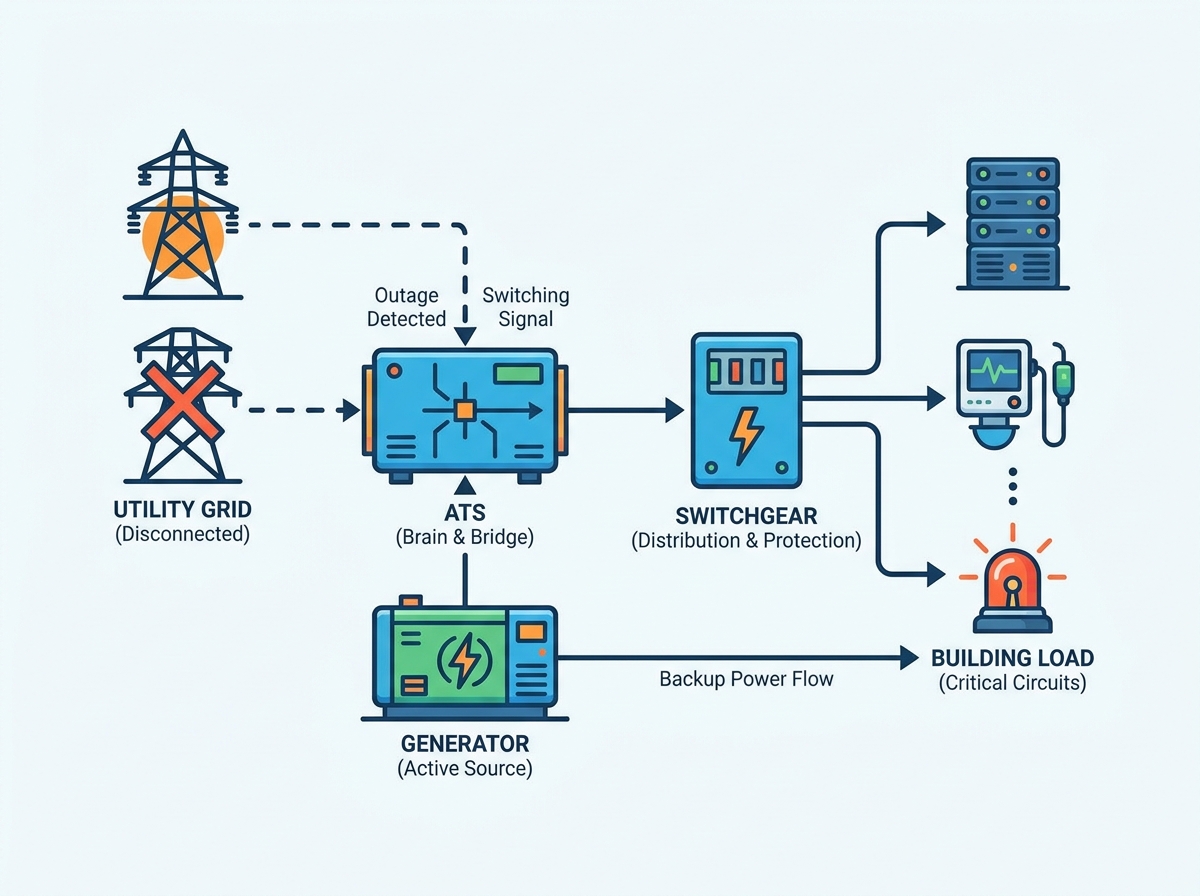
A resilient facility relies on a closed-loop emergency response. This system depends on a distinct triad of components. You need a robust generator, an Automatic Transfer Switch (ATS), and reliable switchgear. They interact continuously to monitor utility feeds. They form the backbone of your facility.
The ATS constantly watches the incoming grid voltage. It senses an anomaly almost instantly. It then sends a start signal to the generator engine. The generator cranks and reaches operational speed. Next, the ATS switches the facility load to this new power source. Finally, the switchgear distributes this energy safely across your building.
An optimized setup achieves sub-10-second power restoration. It maintains load stability during sudden transitions. You avoid dangerous voltage drops completely. The system securely isolates your building. It physically disconnects you from the dead utility grid. This prevents deadly backfeeding into public power lines.
Many buyers make a critical mistake here. They purchase components from mismatched performance tiers. Some choose a premium engine but install budget-grade switchgear. Others mix incompatible digital communication protocols. These component silos lead to catastrophic integration failures. A disjointed system will fail during a real blackout. You must demand seamless compatibility across all three pillars. Your engineering team must verify these communication handshakes early.
Facility planning begins by evaluating space requirements. The physical footprint extends far beyond the engine block. You must allocate substantial room for bulk fuel tanks. Exhaust routing requires significant overhead clearance. Technicians need at least three feet of walking space around the unit. This clearance ensures safe maintenance access.
Environmental compliance strongly drives room design. NFPA 110 standards dictate strict rules. They govern Emergency and Standby Power Systems (EPSS). Mission-critical facilities must adhere to specific Class and Type designations. For example, a "Type 10" system must restore power within ten seconds. A "Class 48" system must carry enough fuel for 48 hours of continuous operation.
Thermal management acts as a critical safety requirement. Generators produce immense heat during operation. Poor ventilation causes severe engine derating. It forces the system to reduce its power output. It can even trigger catastrophic failure during extended runtime. You must implement robust airflow solutions. Motorized louvers and massive radiator fans pull fresh air across the engine.
Municipal codes enforce strict acoustic regulations. Urban environments limit allowable decibel levels at the property line. You often need specialized sound attenuation enclosures. These custom housings absorb engine vibration and mechanical noise. Emissions standards might require advanced exhaust scrubbing technologies. You may need diesel particulate filters to meet local clean air mandates.
Do not underestimate implementation risks here. Retrofitting an existing room presents steep engineering challenges. It often costs more than new construction. You face structural reinforcement needs. Existing walls may not support heavy exhaust piping. Older buildings usually lack restrictive exhaust pathways. Upgrading these spaces requires careful architectural planning.
You must understand the exact roles of these vital devices. They perform very different tasks.
The ATS functions as the intelligent bridge. It monitors utility power continuously. Upon detecting a failure, it signals the generator. It then safely transfers your load to the backup source.
Switchgear serves as the distributor and protector. It routes power to specific building circuits. It utilizes heavy-duty circuit breakers. These breakers prevent dangerous electrical overloads. They isolate electrical faults before they spread.
Evaluate an ATS based on its transition types. You can choose open transition switching. This causes a brief flicker during the switch. Alternatively, closed transition switching works best for sensitive loads. It synchronizes the generator and the grid briefly. It prevents momentary power loss entirely. You should also consider bypass-isolation features. They allow concurrent maintainability. You can safely service the ATS mechanism. You never have to take your facility offline.
Evaluate switchgear based on facility size. You must choose between low-voltage and medium-voltage configurations. Low-voltage works well for standard commercial buildings. Medium-voltage handles massive industrial campuses. Modern smart switchgear offers digital load shedding. It provides real-time analytics. Traditional mechanical setups lack these advanced capabilities.
Feature | Automatic Transfer Switch (ATS) | Switchgear |
|---|---|---|
Primary Function | Switches power source from utility to generator. | Distributes power to facility circuits safely. |
Fault Protection | Minimal. Relies on external breakers. | High. Contains main and branch circuit breakers. |
Placement | Between the utility feed and the generator. | Downstream from the ATS, feeding the building. |
Maintenance Needs | Mechanism calibration and contact cleaning. | Thermography scanning and breaker testing. |
Beware of vendor lock-in. Using a single manufacturer simplifies your initial setup. However, it severely restricts your future flexibility. Integrating best-of-breed components offers better long-term value. You simply use standard communication protocols. Modbus and BACnet allow different brands to talk perfectly. This open architecture prevents future pricing monopolies.
Facility leaders must conduct rigorous load profiling first. Accurate load analysis prevents common sizing pitfalls. You should attach data loggers to your main electrical panels. Record power usage for thirty continuous days. This reveals your true peak demands.
Over-sizing a generator causes wet stacking in diesel engines. Unburned fuel accumulates in the exhaust system. This ruins efficiency and creates fire hazards. Under-sizing leads to dropped loads. It causes immediate equipment damage. You must specify the exact right capacity.
Fuel source selection dictates your performance outcomes. Each fuel type carries distinct operational traits.
Diesel: Offers incredibly high energy density. It provides the fastest response times. However, diesel requires stringent fuel polishing. You must manage on-site storage carefully to prevent degradation.
Natural Gas: Guarantees a continuous, piped fuel supply. It burns much cleaner. You avoid massive on-site storage tanks. Yet, municipal pipelines remain vulnerable. Earthquakes or severe weather can disrupt this supply network entirely.
You also need to plan for scalability. Businesses grow, and power demands increase. Growing data centers require parallel generator capabilities. You can link multiple smaller engines together. Healthcare campuses rely heavily on N+1 redundancy. This means you install one more generator than you strictly need. Adaptable emergency generator systems for commercial buildings scale easily. You can add capacity without replacing the entire infrastructure.
Hidden installation challenges surprise many facility managers. Do not focus solely on the equipment purchase. You must account for heavy craning and rigging procedures. Navigating a large engine into a basement requires specialized logistics. Street closures and city permits require advanced planning.
Structural concrete pads require specialized engineering. A running generator creates immense vibration. The foundation must absorb these dynamic forces. Upgrading existing electrical panels often becomes necessary. Older panels cannot accept the new switchgear connections. You may need a complete electrical room overhaul.
Commissioning realities demand rigorous oversight. You cannot skip site acceptance testing (SAT). Installers must prove the system works under real stress. Load bank testing remains absolutely mandatory. Technicians attach massive artificial loads to the generator. They run it at maximum capacity for several hours. You must verify full system capacity before facility handover. This guarantees the engine will not overheat during an actual crisis.
Long-term operations require dedicated inspection routines. You need strict schedules for ATS calibration. Contacts wear down over time. Switchgear demands annual thermography inspections. Technicians use infrared cameras to spot loose, overheating connections. The generator requires comprehensive preventative maintenance. You must change oil, replace filters, and test batteries. Proper upkeep ensures rapid deployment during an actual blackout.
Your procurement matrix needs strict, measurable parameters. Baseline specifications only scratch the surface. An effective Request for Proposal (RFP) demands stringent service level agreements (SLAs). You must verify guaranteed replacement parts availability. Always check the physical proximity of OEM-certified technicians. You need them on-site within hours, not days.
Engaging a specialized electrical engineer remains a mandatory first step. They conduct a thorough site audit. Do this before contacting any equipment dealers. Independent engineers protect your best interests. They design a system tailored to your unique facility layout.
Follow these immediate next steps to secure your facility:
Audit your current historical load data thoroughly. Identify seasonal peaks.
Categorize building circuits into critical and non-critical tiers. Map out essential life-safety systems.
Schedule a comprehensive NFPA compliance review. Verify local building codes.
Draft an initial spatial plan for the equipment footprint. Measure access doors and overhead clearances.
Consult a certified system design specialist for technical validation.
Executing these steps systematically eliminates guesswork. You build a highly resilient infrastructure.
A successful backup power strategy demands perfect component harmony. It seamlessly integrates your generator room layout. Precise ATS selection forms the automated brain of the operation. Robust switchgear distribution protects your vital building circuits. Buying standalone equipment without an integration strategy invites failure. Every piece must communicate flawlessly. We strongly encourage readers to request a comprehensive site power audit. Reach out to evaluate your specific facility requirements. Secure a reliable commercial backup power generator today. Protect your assets from unpredictable grid failures. Contact our experts to design your optimal commercial backup power generator setup and begin your infrastructure upgrade.
A: NFPA 110 sets strict standards for Level 1 Emergency Power Supply Systems. These systems support life-safety critical operations. They must restore power within exactly 10 seconds of a utility failure. This rule protects hospitals, emergency shelters, and essential data centers. It ensures life-support equipment and emergency lighting remain functional. Your engine, ATS, and switchgear must coordinate perfectly to meet this rapid deployment metric.
A: Yes, you can upgrade an ATS independently. However, you must verify strict compatibility. The new ATS must match the existing generator's voltage and phase configuration. You also need to ensure the digital communication protocols align. Older generators may rely on simple two-wire start signals. Modern transfer switches handle complex network data. Consult an electrical engineer to ensure flawless integration between old and new components.
A: A generator's main circuit breaker only protects the alternator from gross overloads. It does not manage your building. Switchgear provides facility-wide power distribution. It splits the massive generator output into smaller, manageable branch circuits. It also facilitates intelligent load shedding. If the generator nears its maximum capacity, the switchgear can automatically disconnect non-essential loads. This prevents a complete system crash during an emergency.
A: High-quality ATS and switchgear typically last between 15 and 25 years. This longevity depends heavily on your maintenance schedule. Regular infrared thermography scans prevent catastrophic electrical fires. Annual exercising of the ATS mechanisms prevents mechanical binding. Environmental factors also play a massive role. Equipment installed in climate-controlled rooms outlasts gear exposed to high humidity or excessive dust. Consistent upkeep maximizes your investment.