Author: Site Editor Publish Time: 2026-06-29 Origin: Site
Facility managers and architects face high-stakes realities when designing modern power systems. Confusing emergency power and backup power is not a simple semantic issue. This misunderstanding dictates strict electrical compliance, jeopardizes facility safety, and threatens overall business continuity. Professionals often use these terms interchangeably in casual conversation. However, electrical codes strictly separate life-safety power from operational continuity power. Getting this wrong can lead to failed safety inspections, massive liability exposure, or disastrous system failures during an outage.
We will establish a clear framework for evaluating which system you actually need. You will learn how legal mandates, risk tolerance, and load profiles influence your power infrastructure choices. This guide breaks down strict code requirements, mandatory response times, and acceptable fuel configurations. You can use this knowledge to make informed decisions protecting both building occupants and core business operations.
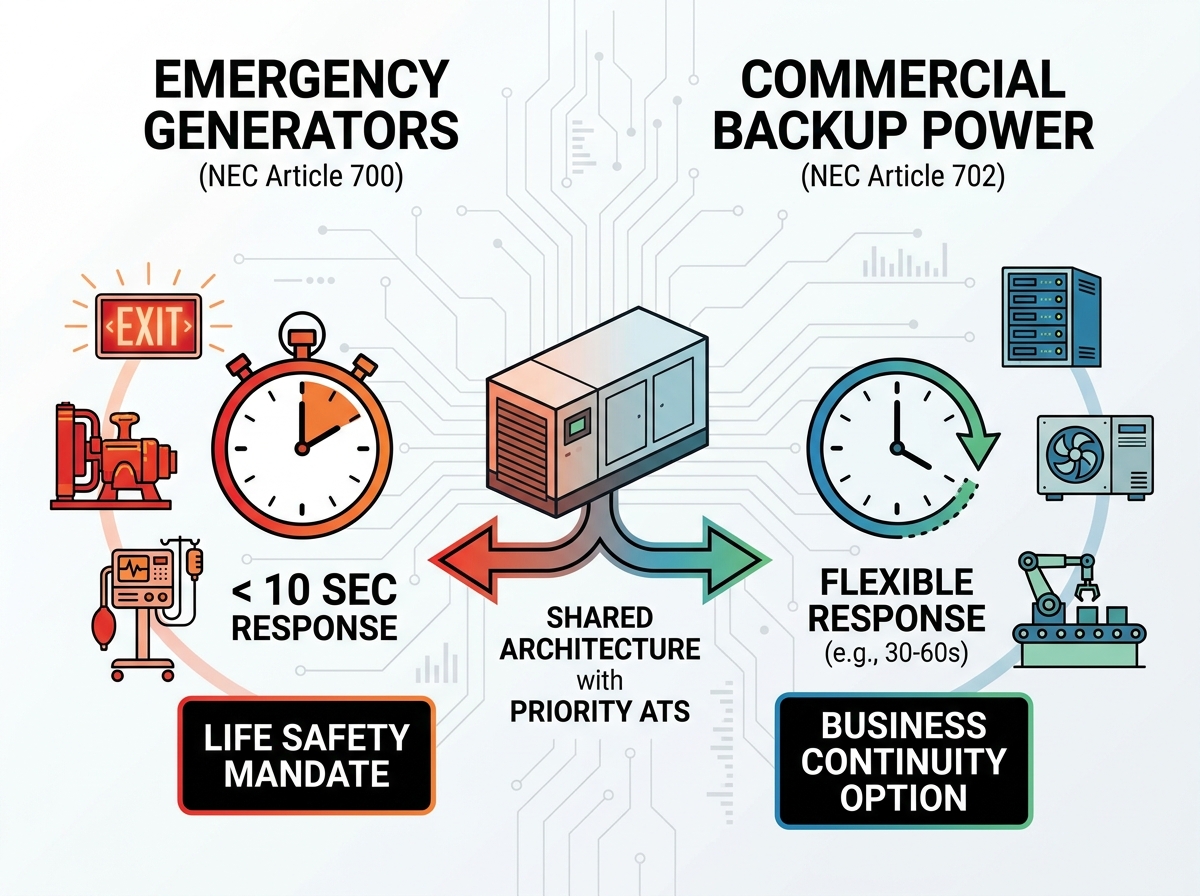
Purpose vs. Preference: Emergency generators are legally mandated for life safety (e.g., egress, fire pumps); commercial backup power generators are optional investments for business continuity (e.g., HVAC, servers, operations).
Response Time Mandates: Emergency systems must typically restore power within 10 seconds. Backup systems have flexible response times based on business tolerance.
Circuit Isolation: Emergency power requires entirely separate, dedicated circuitry and transfer switches to prevent system failure.
System Integration: A single commercial generator can serve both emergency and backup functions, provided it utilizes separate Automatic Transfer Switches (ATS) and prioritizes life-safety loads.
Understanding the legal definitions of electrical systems prevents costly design mistakes. National standards classify power generation into distinct categories based on human safety risks. The National Electrical Code (NEC) governs these classifications.
NEC Article 700 defines emergency systems as legally mandated infrastructure designed solely to protect human life. Local municipal codes and fire marshals dictate these requirements. You must install these systems in specific facility types, such as high-rises, hospitals, and assembly halls.
These units power critical life-safety applications. Typical loads include egress lighting, fire alarm systems, smoke evacuation fans, elevators, and life-support equipment. Regulatory bodies enforce strict standards on these installations. They are subject to rigorous NFPA 110 (Standard for Emergency and Standby Power Systems) mandates. Compliance means adhering to unyielding installation, testing, and maintenance protocols.
The NEC classifies other systems under Article 702 as "Optional Standby" systems. We typically call these commercial backup generators. Facility owners choose to install these systems voluntarily. They exist to prevent financial loss, stop data corruption, or maintain operational uptime during grid failures.
These systems support entirely different applications. Common loads include data centers, commercial refrigeration units, general office lighting, HVAC systems, and production machinery. Because human life does not depend on them, they offer significant design flexibility. They face fewer regulatory constraints regarding specific load types and strict circuit isolation.
Designers must evaluate power systems across several rigid dimensions. Emergency generators for commercial buildings operate under drastically different rules compared to voluntary standby infrastructure.
Code dictates strict timing for life-safety power restoration. Emergency systems must detect a grid failure, start the engine, reach full speed, and transfer power within 10 seconds. This rapid response prevents panic in dark stairwells and keeps critical fire pumps active. In contrast, commercial backup systems allow variable timing. Business owners often accept 30 to 60 seconds for optional standby loads. Delaying the startup of HVAC units or non-critical lighting reduces mechanical stress on the alternator.
Implementation realities vary wildly between the two systems. Emergency loads demand independent wiring pathways. Installers must route these circuits through dedicated conduits and separate panels. This isolation ensures general operational faults never compromise life-safety power. If a massive short circuit occurs in the main office server room, it will not trip the breakers powering the fire alarms.
Fuel sourcing presents a major divergence in system planning.
Emergency Fuel Risks: Regulators often mandate on-site fuel storage. Diesel remains the most common choice. Depending on the facility class, codes dictate run-time capacities ranging from 2 to 96 hours. This on-site supply avoids reliance on vulnerable public utilities during natural disasters.
Backup Fuel Risks: Optional systems frequently utilize continuous natural gas utility lines. This approach reduces on-site fuel maintenance requirements. It eliminates the need for expensive fuel polishing. However, it carries distinct grid-dependency risks. Earthquakes or severe freezes can disrupt natural gas pipelines.
The following chart illustrates the distinct operational differences.
Evaluation Dimension | Emergency System (NEC 700) | Commercial Backup (NEC 702) |
|---|---|---|
Primary Goal | Protect human life | Ensure business continuity |
Mandatory Response | ≤ 10 Seconds | Variable (Based on preference) |
Circuit Design | Completely isolated pathways | Shared or integrated panels |
Fuel Supply | Usually on-site (code dictated) | Flexible (Utility or on-site) |
Facility budgets rarely accommodate infinite infrastructure spending. Decision-makers often face a specific implementation dilemma. Do they buy two separate generators, or can one larger unit handle both functions?
A single unit is usually the preferred economic choice. You can consolidate maintenance efforts and reduce the physical footprint. However, merging life-safety loads and business operations into one power source requires precise engineering.
A single, properly sized commercial backup power generator can legally serve emergency loads. To do this, it must feature multiple Automatic Transfer Switches (ATS). The system must prioritize life-safety circuits above all else. If the generator approaches its maximum capacity, intelligent controls will automatically disconnect (or "shed") the optional standby loads. This load shedding guarantees the fire pumps and egress lighting remain fully powered.
Engineers must size the equipment based on physics, not just simple arithmetic. You must calculate the absolute peak inrush current of the emergency loads first. Large electric motors require massive surges of power to start turning. The generator must absorb this sudden demand before stepping onto secondary optional loads. If you ignore these electrical spikes, you risk systemic failure.
Failing to account for motor-starting demands creates severe adoption risks. If a heavy fire pump attempts to start and the alternator lacks adequate rotational inertia, the generator will stall. A stalled engine drops the entire facility back into darkness. This violates fire codes and introduces unacceptable liability.
Selecting the proper fuel source dictates your maintenance schedule and reliability profile. Commercial and industrial (C&I) facilities primarily evaluate three options.
Diesel remains the traditional gold standard for emergency compliance. It offers incredibly fast startup times. Diesel engines produce exceptional torque, easily handling heavy motor loads. Authorities readily accept diesel for on-site fuel requirements. Common Mistake: Ignoring wet-stacking risks. Running a diesel engine under minimal load causes unburned fuel to accumulate in the exhaust system. This requires expensive load-bank testing and regular fuel polishing to prevent degradation.
Natural gas represents a growing preference for operational backup. It provides theoretically infinite run-time as long as the utility flows. It burns cleaner, producing lower emissions. It also requires significantly less routine maintenance. Caveat: Natural gas infrastructure remains vulnerable to pipeline disruptions. Major seismic events or deep freeze conditions can stop fuel delivery. Furthermore, local life-safety codes may reject natural gas for strict emergency applications due to this utility reliance.
Bi-fuel systems present a robust hybrid solution. These engines start on diesel for immediate torque and fast response. Once running, they seamlessly blend in natural gas. This strategy maximizes reliability and greatly extends on-site fuel reserves. It effectively mitigates single-source fuel risks.
A power system holds no value if it fails during a blackout. Routine maintenance distinguishes a reliable asset from a dangerous liability.
Compliance requires distinct testing regimens. NFPA standards mandate strictly documented monthly load-bank testing for life-safety systems. Technicians must run the equipment under specific loads to ensure operational readiness. Conversely, standard backup units usually rely on manufacturer-recommended preventative maintenance. These optional schedules lack the legal enforcement seen in life-safety testing.
Risk management relies heavily on documentation. Emergency systems require rigorous, auditable maintenance logs. If an incident occurs and the egress lights fail, investigators will demand these records. Proper documentation protects the organization from severe legal liability. Missing logs indicate negligence.
Adopt a proactive stance regarding infrastructure health. Waiting for an outage is a terrible strategy.
Fluid Analysis: Conduct routine oil and coolant sampling to detect engine wear early.
Battery Inspections: Most startup failures stem from dead starter batteries. Test and replace them proactively.
ATS Sequencing Checks: Verify the transfer switches prioritize the correct panels during simulated outages.
Visual Inspections: Check for fuel leaks, loose wiring, and debris around the air intakes weekly.
Moving from theory to procurement requires a structured approach. Avoid buying equipment based purely on generalized kilowatt estimates.
Start by identifying your legal obligations. Consult a licensed electrical engineer. They will define the non-negotiable emergency loads required by local Authorities Having Jurisdiction (AHJs). You cannot proceed without this baseline data.
Next, determine what optional systems justify the expense of backup power. Conduct a thorough commercial load study. Will losing the HVAC system for 24 hours ruin your inventory? Can your servers handle a hard shutdown? Identify exactly which systems generate revenue and calculate the cost of their downtime.
Follow a logical path to final selection. Once you identify all loads, choose the appropriate ATS architecture. Next, evaluate your available physical footprint and fuel options. Finally, before purchasing your commercial backup power generator, consult local code officials to verify your planned architecture meets all regulatory standards.
Recognize "emergency power" as a strict, legally mandated life-safety designation requiring isolated circuits and fast response times.
Treat "backup power" as a flexible, economic continuity decision designed to protect operational revenue.
Never guess your capacity needs; always base your final investment on a rigorous, engineer-led electrical load profile analysis.
Coordinate closely with local code officials and AHJs prior to finalizing any shared-generator system architectures.
A: Yes, but only under strict conditions. You must install independent circuitry and use priority ATS staging. The system must automatically shed optional loads to prioritize life-safety circuits. You must also verify full compliance with local fire codes and AHJ mandates.
A: The facility instantly fails electrical and fire code compliance. This failure risks your building occupancy permits. In an actual emergency, a delayed startup creates severe legal liability issues and threatens the physical safety of building occupants.
A: UPS systems bridge the immediate power gap, especially for critical IT infrastructure. However, they usually serve as a complement to a larger mechanical system. They generally do not replace the legal requirement for a code-compliant, engine-driven emergency generator.
A: Legal requirements depend entirely on building height, specific occupancy type, and local NFPA or IBC adoptions. Hospitals, high-rises, and large assembly venues typically require them. Always consult a local AHJ to determine your exact legal obligations.