Author: Site Editor Publish Time: 2026-07-19 Origin: Site
Grid instability and extreme weather events are no longer remote possibilities. They act as inevitable operational liabilities threatening modern enterprises everywhere. When the lights go out, businesses face much more than temporary inconveniences. Unplanned outages lead directly to catastrophic financial losses. Spoiled inventory, broken service level agreements, and halted production lines destroy quarterly margins. Every minute offline bleeds capital. It also damages hard-earned client trust.
To combat these risks, deploying a reliable commercial backup power generator is not just a luxury equipment purchase. It serves as a measurable, foundational risk mitigation strategy. It protects your core revenue streams. It ensures strict regulatory compliance. It preserves client confidence during widespread disasters. In this article, you will learn how to calculate the true cost of downtime. We will analyze system mechanics and evaluate sizing requirements. You will also discover local compliance standards and actionable steps to safeguard your facility.
Unplanned downtime incurs both hard costs (lost revenue, ruined goods) and soft costs (reputational damage, SLA penalties).
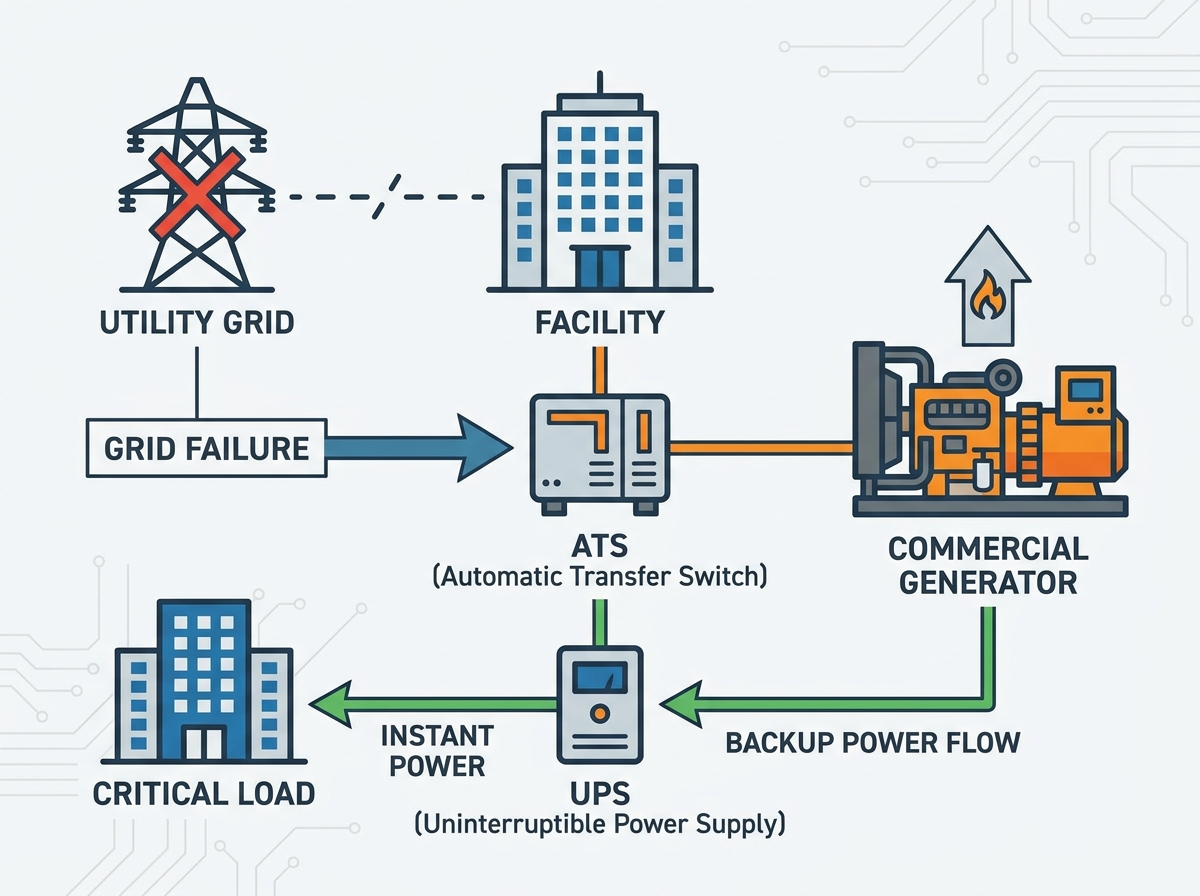
Automatic Transfer Switches (ATS) paired with Uninterruptible Power Supply (UPS) systems eliminate the "gap" in power for mission-critical facilities.
Proper system evaluation requires analyzing facility load requirements, fuel availability, and local zoning compliance.
Unplanned power outages drain business capital rapidly and mercilessly. Calculating the per-hour cost of halted operations reveals shocking numbers for most organizations. Point-of-sale system failures prevent retail transactions instantly. Assembly line shutdowns stop manufacturing output completely, creating severe supply chain backlogs. Unbillable hours accumulate rapidly when employees cannot access cloud applications or digital tools.
Sector-specific risks compound these direct revenue interruptions significantly. Cold chain spoilage in food service destroys valuable perishables in mere hours. In medical facilities, a temperature drop can ruin life-saving vaccines and sensitive biological samples. A sudden power drop often damages expensive industrial machinery. Sensitive electronics face severe risks from voltage sags. You face massive inventory and hard asset losses within minutes of a blackout.
Service-level agreement (SLA) penalties pose another massive financial threat. Failing to meet guaranteed uptime for clients triggers severe legal and financial liabilities. IT providers, data centers, and critical B2B services suffer intensely during outages. Reputational damage often outlasts the actual physical event. Clients leave quickly when they cannot rely on your infrastructure. Rebuilding market trust takes years.
You must evaluate the ROI perspective carefully. Compare the upfront cost of your backup infrastructure against projected annualized downtime losses. Historical outage data helps quantify this specific risk. Robust commercial backup power generators pay for themselves by preventing just one major disruptive event. We consistently see businesses save millions by averting catastrophic operational halts. Evaluating risk this way makes procurement decisions highly objective.
The Automatic Transfer Switch (ATS) acts as the autonomous brain of your electrical infrastructure. When a grid failure occurs, the ATS detects the voltage drop immediately. It then isolates your facility's internal circuit from the dead utility line. This crucial step prevents deadly back-feeding into the grid. Utility workers repairing lines rely on this isolation for their safety. Next, the ATS commands the engine to start. Once the system reaches the correct voltage and frequency, it seamlessly transfers the load. This happens entirely without human intervention.
Mechanical engines require a brief start-up delay. This delay usually lasts between 10 and 30 seconds. High-stakes environments simply cannot afford even this tiny disruption. Hospitals, data centers, and emergency call centers bridge this gap using Uninterruptible Power Supply (UPS) integration. The UPS provides instantaneous battery power the millisecond the grid fails. It carries the entire electrical load while the engine cranks and stabilizes. This synergy achieves true "zero downtime" for critical applications.
Power quality and load management determine overall system stability. You must ensure the power delivered remains perfectly stable. Voltage fluctuations easily damage servers and telecommunications gear. Load shedding algorithms help manage capacity efficiently. They direct power to life-safety systems and core servers first. HVAC systems, decorative lighting, and secondary panels receive power only if reserve capacity permits. This intelligent prioritization prevents system overloads. It keeps your most vital operations running smoothly under severe duress.
Sizing your system correctly prevents devastating operational failures. Moving from basic kilowatts to industrial megawatts requires engineering precision. Undersizing leads directly to catastrophic system failure under peak loads. An overloaded engine will trip its safety breakers and shut down entirely. Conversely, oversizing wastes valuable capital and fuel. Diesel engines running on low loads suffer from a condition called "wet stacking." This builds up unburned fuel and carbon in the exhaust. It quickly degrades engine efficiency and lifespan.
Comparing fuel sources is critical for long-term reliability. We outline the primary industry options below:
Diesel: Offers high energy density and extremely rapid response times. However, it requires large onsite storage tanks and routine fuel polishing. You must also adhere to increasingly strict local emissions regulations.
Natural Gas: Provides a continuous fuel supply directly via underground utility lines. It burns much cleaner than diesel. Yet, it remains vulnerable if a severe earthquake or disaster disrupts local gas infrastructure.
Bi-Fuel Systems: Blend natural gas and diesel dynamically during operation. They offer extended runtime and excellent redundancy for critical, high-demand applications.
Industry-specific considerations heavily influence your hardware selection. A retail store might need a basic standby unit. This powers cash registers, security cameras, and emergency lights safely. In stark contrast, heavy industrial manufacturing requires continuous-rated setups. These facilities pull massive startup currents for heavy motors. Your commercial backup power generator must align flawlessly with your exact operational cadence.
System Capability Comparison Guide
Fuel Category | Primary Advantages | Main Drawbacks | Best Fit Scenarios |
|---|---|---|---|
Diesel Systems | Fast start, high energy density, independent storage | Strict emissions, fuel degrades over time | Standalone facilities, heavy industry, rural sites |
Natural Gas Systems | Continuous pipeline supply, cleaner burning profile | Highly vulnerable to pipeline disruptions | Urban environments, emissions-restricted zones |
Bi-Fuel Technology | High redundancy, maximizes extended runtime | Higher upfront engineering complexity and cost | Large data centers, critical healthcare facilities |
Proper installation goes far beyond simply wiring a machine. You must assess architectural and spatial constraints very early. Heavy industrial equipment requires specialized, reinforced concrete pads. You often need heavy crane access for rooftop or tight-alley installations. Secure perimeter fencing protects your vital investment from tampering, vandalism, or theft. Careful physical planning prevents costly installation delays.
Acoustic and environmental zoning presents significant municipal hurdles. Local ordinances heavily restrict acceptable decibel levels near commercial property lines. You must navigate complex exhaust routing rules carefully. Pumping fumes into neighboring building air intakes violates environmental health codes. Installing hospital-grade silencers and sound-attenuated enclosures often resolves these noise compliance issues effectively.
Fire codes and safety compliance mandate rigorous engineering reviews. You must adhere tightly to National Fire Protection Association (NFPA) standards. NFPA 110 outlines strict guidelines for emergency and standby power setups. True compliance ensures life-safety circuits remain fully energized during catastrophic building events. Fire marshals inspect these systems rigorously before granting occupancy permits.
Do not ignore the hidden physical risks of neglect. Your hardware is only as reliable as its ongoing maintenance schedule. Routine load bank testing artificially loads the engine to 100% capacity. This process burns off harmful carbon deposits and verifies true performance. Regular fluid analysis detects internal engine wear before catastrophic failure occurs. Strict maintenance habits guarantee your infrastructure starts when you need it most.
Establishing a solid business case streamlines the entire procurement process. You must first define clear, measurable success criteria. Establish the minimum viable uptime requirements for your specific operation. Identify critical versus non-critical electrical panels accurately. You do not always need to power the entire building during an emergency. Prioritizing server rooms, medical equipment, and security systems over breakroom outlets saves immense capital.
Use a structured vendor evaluation matrix when selecting an installation partner. Look closely for comprehensive turnkey engineering capabilities. Ask specifically about post-sale maintenance contracts and rapid-response guarantees. Favorable warranty terms protect your long-term capital investment. You should evaluate their track record with similarly sized commercial deployments in your specific industry.
Define critical facility loads and operational uptime goals clearly.
Assess physical site constraints, acoustic limits, and zoning laws.
Compare equipment vendors using a standardized evaluation matrix.
Secure long-term maintenance, testing, and fluid analysis contracts.
Your actionable next step is conducting a professional site energy audit. A certified electrical engineer must perform a detailed, multi-day load analysis. They use power loggers to measure true peak demands. This step finalizes your precise technical specifications. Complete this thorough audit before issuing any formal Request for Proposal (RFP).
Unpredictable grid failures do not have to dictate your operational success. Investing in robust standby power transforms major disasters into highly managed, minor events. It secures your facility against extreme weather and aging grid infrastructure. You regain complete control over your facility's operational uptime.
Evaluating your return on investment requires looking far beyond the hardware price tag. You must weigh the system cost directly against the massive financial impact of total downtime. Lost inventory, SLA fines, and permanent brand damage cost far more than preventive infrastructure. Action-oriented planning prevents these easily avoidable losses.
Protect your business continuity today. We highly encourage facilities managers and operations directors to act immediately. Schedule a comprehensive site load assessment with a certified specialist. Finalize your critical power requirements and secure your operational future against inevitable grid disruptions.
A: Mechanical systems typically experience a 10-to-30-second delay. During this brief window, the Automatic Transfer Switch (ATS) senses the outage, isolates the circuit, and signals the engine to start. For facilities requiring zero downtime, Uninterruptible Power Supply (UPS) battery systems carry the electrical load until the engine reaches full speed.
A: You do not have to power the entire building. Partial load management separates your circuits. Emergency panels prioritize life-safety systems, core servers, and critical machinery. Non-essential areas like breakrooms or decorative lighting remain unpowered. This strategy allows you to install a smaller, much more cost-effective system.
A: When properly maintained, these heavy-duty systems boast incredibly long operational lifespans. Diesel and natural gas engines typically last between 10,000 and 30,000 operational hours. In a standby capacity, running only during outages and routine weekly testing, a well-maintained unit can easily last 20 to 30 years.
A: Facilities should schedule weekly or monthly automated no-load self-tests. Quarterly professional inspections check vital fluids, starting batteries, and block heaters. An annual comprehensive service is mandatory. This yearly check includes deep fluid analysis, fuel filter replacements, and full-capacity load bank testing to ensure peak emergency performance.