Author: Site Editor Publish Time: 2026-07-13 Origin: Site
Data center downtime carries extreme financial and reputational costs. Modern businesses rely on uninterrupted digital infrastructure. For mission-critical facilities, the handoff from UPS battery banks to the generator remains the single most critical point of failure. You simply cannot afford to get this transition wrong.
Sourcing a commercial backup power generator involves much more than calculating peak wattage. Facility managers must balance complex redundancy topologies. They must navigate stringent emissions regulations. They also need to mitigate global fuel supply chain risks. Facility leaders face mounting pressure. They must guarantee perfect uptime while simultaneously hitting strict sustainability targets.
This guide provides an objective, procurement-focused framework for evaluating your options. We will help you size, select, and deploy the right equipment for your data center environments. You will learn how to align redundancy architectures with compliance requirements. We aim to protect your facility from unexpected blackouts and regulatory fines.
Redundancy architectures (N+1 vs. 2N) directly dictate base generator sizing and parallel switching complexity.
While diesel remains the industry standard for rapid transient response, natural gas is increasingly viable due to strict local emission constraints.
Acoustic compliance (noise pollution) and EPA tier regulations are currently the most common deployment bottlenecks for urban data centers.
Data centers require flawless power continuity at all times. A brief micro-second interruption can cascade into massive data loss. Corrupted databases take hours to rebuild. You need clear, uncompromising success criteria to evaluate hardware effectively. This means looking closely at recognized industry standards. You must analyze load handling characteristics deeply. You also need to understand engine rating limitations.
The Uptime Institute provides a definitive classification system for data centers. Tier I through Tier IV standards dictate specific generator runtime requirements. They also define strict concurrent maintainability limits. For example, Tier IV facilities demand entirely fault-tolerant power systems. You must guarantee continuous operation even during planned maintenance or unexpected part failures. If a mechanic takes one engine offline for servicing, the facility must remain fully protected. Your chosen equipment must align perfectly with your facility's targeted tier certification. Failing to match these standards jeopardizes your compliance status.
Transient response measures how quickly the engine reacts to sudden load changes. When utility power fails, UPS systems carry the facility temporarily. The engine must wake up, stabilize its voltage, and accept 100% of the facility load rapidly. Look for models capable of fast step-load acceptance. Sub-standard transient performance causes dangerous voltage dips. These dips can trip sensitive IT equipment offline. They can also cause precision cooling chillers to lock out. A delayed cooling restart leads to rapid thermal runaway on the data floor.
You will see Standby, Prime, and Continuous power ratings on specification sheets. Standby ratings apply to typical commercial buildings facing rare outages. Data centers operate differently. They need Data Center Continuous (DCC) ratings. Alternatively, they use highly conservative standby models. DCC ratings guarantee the engine can handle a constant 100% load indefinitely. ISO 8528-1 compliance ensures the unit meets strict operational limits. Never deploy a standard standby rating for a Tier IV data floor.
Selecting the right fuel fundamentally changes your facility design. It impacts your emissions footprint directly. It dictates your maintenance schedules and runtime limits. You must weigh the pros and cons of traditional and alternative fuels carefully. Here, we analyze the top choices for modern facilities. Let us explore how they fit into modern commercial emergency generator systems.
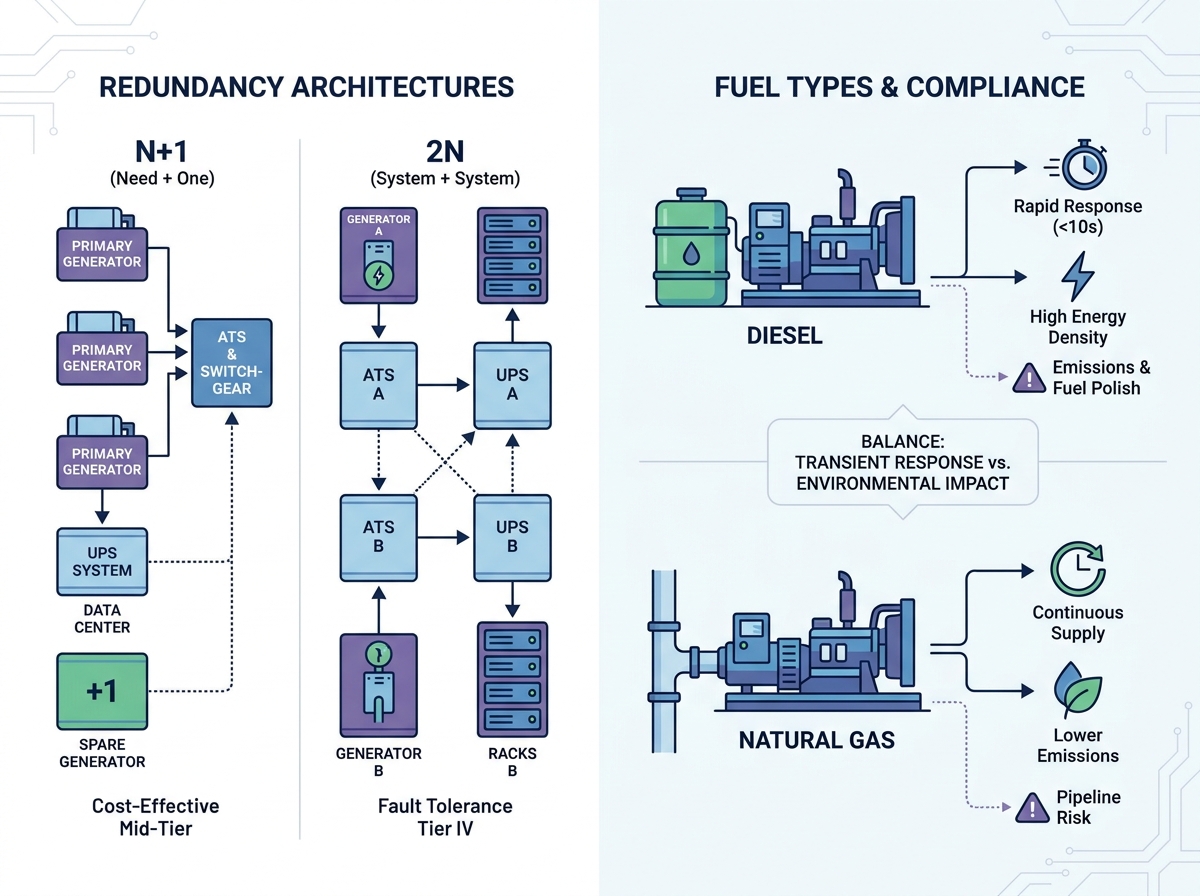
Diesel dominates the data center landscape for a highly practical reason. It delivers proven, uncompromising reliability during utility outages.
Diesel offers exceptional volumetric energy density. These engines provide rapid, sub-10-second start times. They handle massive block loads effortlessly. The deep market familiarity means you will find replacement parts easily. Mechanics understand diesel engines intimately. This widespread knowledge accelerates emergency repairs.
You must manage fuel degradation carefully. Diesel requires routine polishing to remove moisture, sediment, and microbes. Stored fuel goes bad within six months without intervention. Operating engines under light loads leads to wet-stacking. This condition pushes unburned fuel into the exhaust system, creating a fire hazard. Furthermore, managing bulk on-site fuel storage demands strict safety protocols. Spill containment zones add structural complexity.
Diesel faces intense regulatory scrutiny globally. You must navigate EPA Tier 4 Final requirements in the United States. Achieving compliance often requires complex Selective Catalytic Reduction (SCR) systems. These additions inject urea into the exhaust stream. SCR systems increase installation complexity. They also increase your footprint and maintenance demands.
Urban centers place strict limits on diesel emissions. Natural gas provides an increasingly attractive, cleaner alternative.
Natural gas engines connect directly to municipal pipelines. This continuous fuel supply eliminates on-site tank logistics completely. You avoid fuel polishing routines entirely. It drastically lowers your carbon and particulate emissions footprint. Facilities experience streamlined environmental permitting processes. Community boards often approve natural gas permits much faster than diesel.
Pipeline vulnerabilities do exist. Severe seismic events can rupture underground lines. Extreme winter storms sometimes freeze municipal pumping stations. You must assess regional infrastructure reliability carefully. Additionally, natural gas engines show marginally slower transient response times compared to diesel. You might need to upsize your UPS battery banks to bridge the gap.
Evaluation Area | Diesel Engines | Natural Gas Engines |
|---|---|---|
On-Site Fuel Storage | Requires bulk underground or belly tanks | Relies on continuous municipal pipeline supply |
Transient Response Speed | Sub-10 seconds (Industry standard) | Marginally slower; requires UPS bridging |
Emissions and Air Quality | High particulate matter; needs SCR additions | Significantly lower emissions profile |
Primary Operational Risks | Fuel degradation, microbial growth, wet-stacking | Pipeline interruption during natural disasters |
Proper sizing prevents catastrophic cascading failures. An undersized engine simply drops the load and shuts down. An oversized engine wastes capital and suffers mechanical issues like wet-stacking. You must profile your facility accurately to avoid both extremes.
You must calculate requirements beyond just the server racks. A data center consumes massive auxiliary power. Precision cooling equipment like CRAH units and chillers often equals the IT load itself. Security systems, emergency lighting, and fire suppression pumps add up quickly. Use historical trending data to build an accurate profile. Always factor in peak summer cooling demands. A system running at 80% capacity in winter might overload during a July heatwave.
Redundancy keeps your facility online during hardware failures. The chosen topology dictates your base sizing and parallel switching complexity.
N+1 (Need plus one): This provides highly cost-effective redundancy. It suits mid-tier, regional facilities perfectly. You install one extra unit beyond the baseline load requirement. If one engine fails during an outage, the backup assumes the load instantly.
2N (System plus system): This architecture offers complete isolation. Tier IV enterprise or hyperscale environments demand 2N designs. Two entirely independent power paths feed the facility continuously. It guarantees uptime even during catastrophic switchgear fires or complete path failures.
You do not need to install your ultimate capacity on day one. Modular scaling saves massive amounts of money. You deploy paralleled generator configurations instead of single massive blocks. Paralleling switchgear synchronizes multiple smaller units together. This strategic approach allows facilities to defer capital expenditure. You simply bolt on additional units as your data floor capacity expands over the years.
Regulations shape data center construction heavily today. Environmental protection agencies monitor large-scale operations closely. You must plan for acoustics, emissions, and future sustainability goals from the start.
Community noise pollution constraints remain strict. Urban data centers often sit surprisingly close to residential zones. A running engine produces deafening, disruptive noise. You must invest in custom sound-attenuated enclosures. Hospital-grade silencers restrict exhaust noise dramatically. You might need sound-dampening walls around the equipment yard. These mitigations ensure compliance with strict local noise ordinances. They also prevent costly legal complaints from surrounding neighborhoods.
Local Air Quality Management District restrictions vary wildly by region. They dictate permissible exhaust emissions strictly. You must calculate allowed run-times for routine maintenance testing carefully. Some regions limit non-emergency operations to just 50 hours annually. Breaching this limit triggers massive fines. Securing permits requires detailed exhaust dispersion modeling. Partnering with experienced environmental engineering consultants accelerates this complicated process.
The tech industry pushes aggressively toward absolute carbon neutrality. You should evaluate vendor product roadmaps carefully. Assess engine compatibility with hydrotreated vegetable oil (HVO). HVO drops into existing diesel systems easily without modifications. It reduces net carbon emissions significantly. Furthermore, consider complex integration potential. Can the engine connect with site-wide microgrids? Will it work alongside massive Battery Energy Storage Systems (BESS)? Future-proofing protects your heavy infrastructure investment.
Even the highest-quality hardware fails without proper installation and care. Execution separates successful projects from costly disasters. You must prioritize precise site logistics, strict testing, and reliable vendor support. We will explore how to secure the ideal commercial backup power generator for your exact operational needs.
Moving extremely heavy machinery requires precise planning. You must factor in giant crane access for rooftop or tight courtyard placements. Structural engineers must design robust, reinforced concrete pads. Vibration isolation mounts prevent engine harmonics from shaking the building structure. Secure fuel routing is equally critical to facility safety. Double-walled piping prevents catastrophic leaks from reaching the soil.
You must validate system reliability frequently and aggressively. Routine load bank testing is absolutely mandatory. It verifies switchgear reliability under maximum stress. Testing prevents diesel engine wet-stacking by burning off internal carbon deposits safely. It also verifies automatic transfer switch (ATS) synchronization. You cannot leave the ATS untested. A failed transfer switch renders the best engine completely useless during a blackout.
Hardware represents only a fraction of the long-term partnership. You must scrutinize Service Level Agreements closely. Shortlist integrators based on guaranteed emergency response times. Ensure they maintain deep regional replacement parts availability. Demand highly transparent preventative maintenance Standard Operating Procedures.
Check guaranteed emergency response times. Demand two-hour or four-hour strict windows.
Verify local stocking levels. Do they hold critical replacement parts nearby?
Review the clarity of their scheduled preventative maintenance routines.
Examine their hands-on experience with mission-critical data center deployments specifically.
Selecting commercial emergency equipment involves extreme complexity. It requires balancing immediate IT load demands against long-term compliance realities. You must navigate environmental constraints carefully. A highly reliable engine secures your facility's reputation against downtime.
Prioritize vendors offering transparent operational modeling. Look for proven, documented data center deployments. Robust local engineering support always outweighs strict upfront hardware costs. A cheap engine quickly becomes a liability if it lacks regional mechanic coverage during a crisis.
Your next immediate step is critical. We strongly recommend commissioning a site-specific load study. Combine this data with a thorough environmental risk assessment. Do this before finalizing any hardware specifications. Precise data drives successful procurement and guarantees continuous uptime.
A: It depends heavily on on-site fuel storage capacity. Diesel setups typically run 48 to 72 hours before needing a refill. You must secure reliable refueling contracts to extend this duration. Natural gas engines can run indefinitely, assuming the municipal pipeline remains uninterrupted during the crisis.
A: Standby ratings handle variable emergency loads with strict annual runtime limits. They suit standard office buildings well. Continuous ratings are designed for a constant 100% load without runtime restrictions. Data centers strictly require Data Center Continuous (DCC) or ISO 8528-1 compliant ratings to ensure uninterrupted performance.
A: Industry standards require rigorous schedules. You should perform monthly no-load or light-load runs. Combine these with annual full-load bank testing. This routine ensures compliance with NFPA 110 guidelines. It also satisfies OEM warranty requirements and prevents detrimental conditions like diesel wet-stacking.