Author: Site Editor Publish Time: 2026-07-08 Origin: Site
Sizing your facility's power system is never a simple math equation. It represents a critical risk-management decision balancing upfront resources against continuous operations. Facility leaders face extremely high stakes during grid outages. Getting this specification wrong exposes your operations to severe vulnerabilities. Undersizing a system often guarantees catastrophic failure when large motors start simultaneously. The resulting voltage dips can instantly crash critical networks. Conversely, oversizing creates massive operational inefficiencies. It directly damages engines through a process called diesel wet stacking. Both sizing extremes severely degrade your operational stability and reliability. We need a more precise, data-driven approach instead. You will learn the engineering-led framework required to accurately assess critical loads. We will explore how to select the exact system architecture for your facility. You will discover practical ways to avoid common compliance traps and ensure long-term readiness.
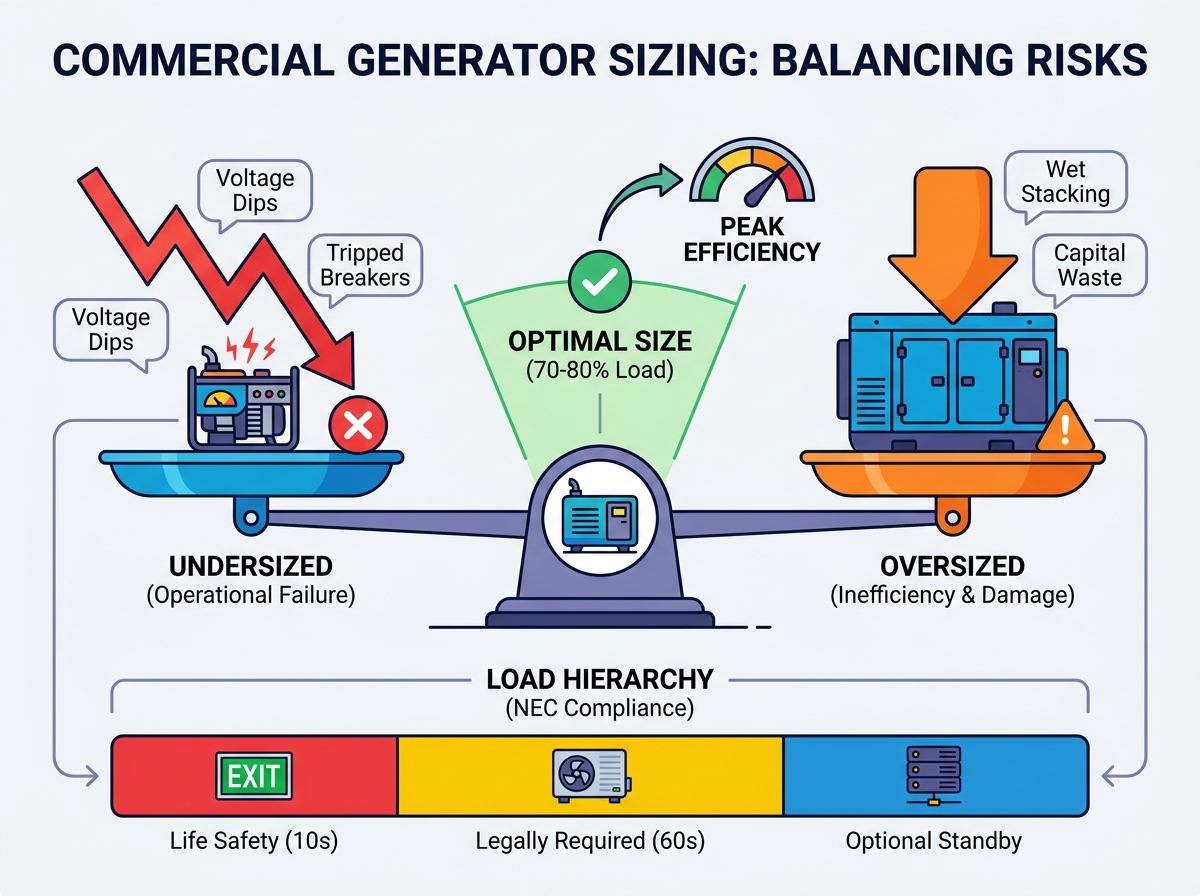
Oversizing is a liability: A commercial backup power generator should typically operate at 70-80% of its rated capacity; running below 30% damages diesel engines.
Starting watts dictate the peak: HVAC systems, industrial motors, and heavy equipment require up to 3x their running wattage during startup (surge demand).
Compliance drives baseline requirements: NEC (National Electrical Code) and NFPA 110 dictate strict separation of life-safety critical loads from optional standby loads.
Data beats "rules of thumb": Relying on square-footage multipliers leads to inaccurate sizing; a proper sizing exercise requires historical utility data and an electrical load analysis.
Precision sizing protects your facility from unpredictable failures. Engineers must calculate exact demands before selecting equipment. Guesswork leads to dangerous operational extremes.
Inadequate capacity creates immediate operational failure during an outage. Large equipment requires massive current spikes to start. If the alternator cannot deliver this inrush current, system voltage plummets. Breakers detect this voltage drop as a major fault. They trip immediately to protect the circuitry. Your facility goes completely dark again. Life-safety systems fail to activate. Critical cooling systems shut down. You lose essential data infrastructure. Undersizing leaves you entirely unprotected when you need power most.
Many managers believe bigger is always better. This is a dangerous misconception. Oversized units run at highly inefficient light loads. Diesel engines require high temperatures for complete combustion. Running below thirty percent capacity keeps cylinders too cool. Unburned fuel and soot mix together in the exhaust. This creates a thick, dark sludge. Engineers call this "wet stacking." It destroys engine performance and creates serious fire hazards. Oversized natural gas units avoid wet stacking but waste significant resources. They operate far below their optimal efficiency bands. You burn excess fuel for zero operational benefit.
A properly specified system meets strict engineering benchmarks. You should target the following success criteria:
It comfortably handles large step-loading sequences without voltage dips.
It meets all local NEC and NFPA code requirements for life safety.
It operates consistently within its 70 to 80 percent peak efficiency band.
It avoids tripping breakers during heavy motor startups.
It provides stable frequency control for sensitive electronic equipment.
You cannot back up everything efficiently. You must prioritize your electrical loads. This requires separating critical infrastructure from optional equipment.
The National Electrical Code defines strict tiers for backup power. You must separate these loads into distinct transfer branches. Life-safety equipment always takes priority over optional facility loads.
NEC Category | Restoration Requirement | Typical Equipment Examples |
|---|---|---|
Emergency / Life Safety (NEC 700) | Within 10 seconds | Egress lighting, fire pumps, panic alarms, public address systems. |
Legally Required Standby (NEC 701) | Within 60 seconds | Smoke extraction, critical HVAC, essential communication networks. |
Optional Standby (NEC 702) | No strict time limit | Standard lighting, non-essential servers, breakroom appliances. |
You must calculate both continuous and peak power demands. Running wattage is the power required during normal operation. Starting wattage is the massive surge needed to start motors. High-inrush equipment includes chillers, air compressors, and heavy manufacturing machinery. These items pull immense temporary loads. NEMA design codes provide standard surge multipliers for different motor types. You often need two to three times the running wattage to clear the startup phase. Failing to account for this surge causes instant alternator stalling.
You do not have to start everything at once. Step-loading allows you to sequence equipment startups. Programmable logic controllers handle this staging automatically. You might start fire pumps first. Ten seconds later, you start the chillers. Twenty seconds later, standard lighting activates. Breaking one massive surge into three smaller surges reduces your peak kilowatt requirement. This strategy allows facilities to safely specify a smaller overall footprint. It improves engine performance and stabilizes frequency.
Every facility has unique technical constraints. You must match the physical equipment to your site infrastructure. Choosing a reliable commercial backup power generator requires understanding several core variables.
Your new unit must perfectly match your facility voltage. Smaller commercial buildings often use 120/240V single-phase power. Large industrial facilities typically require 277/480V three-phase power. Mismatching these specifications requires expensive external transformers. You must verify your main service panel ratings before ordering equipment. Three-phase systems handle large motor loads much more efficiently. They distribute the power draw evenly across three distinct lines.
Manufacturers rate equipment based on operational duration. The ISO 8528 standard defines these specific classifications. A standby rating applies to emergency grid outages. It assumes varying loads for a limited annual runtime. A prime power rating applies to primary off-grid usage. Prime units run continuously for unlimited hours. You must select the rating that matches your operational intent. Using a standby unit for prime continuous power voids manufacturer warranties quickly.
Your choice of fuel drastically impacts physical sizing and performance. Diesel offers incredibly high power density. It provides unmatched instantaneous torque for heavy motor starting. However, diesel remains highly vulnerable to light-load damage. Natural gas provides a reliable, continuous utility supply. It produces lower on-site emissions. When specifying a natural gas commercial backup power generator, you face different constraints. Natural gas often requires a significantly larger engine block. It needs more physical displacement to achieve the same kilowatt output as diesel. It also responds slightly slower to massive transient step-loads.
Calculations on paper rarely match site realities perfectly. You must account for physical restrictions and environmental variables. Overlooking these details halts installations completely.
Units require significant physical space for operation and maintenance. Custom weather enclosures add bulk to the base frame. Local zoning laws enforce strict sound attenuation limits. You may need custom acoustic enclosures to meet restrictive dbA limits. Exhaust clearances are also heavily regulated. You cannot place exhaust stacks near building air intakes. Technicians need three feet of clearance around all sides for servicing. You must map these dimensions onto your site plan early.
Fuel logistics often dictate your final system design. NFPA 110 mandates specific runtime minimums for life-safety applications. Facilities typically need 24-to-72 hour minimum runtime tanks. These large sub-base tanks drastically increase the total unit height. Environmental regulations mandate secondary containment basins. You must capture any potential fuel or oil spills. This secondary containment adds further complexity to your concrete pad design. You must integrate these structural requirements before pouring any foundations.
Generators rarely produce their perfect nominal output in the real world. Environmental extremes reduce their actual capacity. Engineers call this reduction "derating." You must apply derating multipliers to your final calculations. Common factors include:
High Altitude: Thinner air reduces combustion efficiency and total power output.
Ambient Temperature: Extreme heat forces cooling systems to work harder, draining available kilowatts.
Site Humidity: High moisture displaces oxygen in the intake air, further reducing performance.
Airflow Restrictions: Tight mechanical rooms restrict intake ventilation and limit radiator cooling.
You now understand the foundational engineering principles. You must transition from theory to active procurement. This requires gathering hard data and questioning vendors rigorously.
Procurement cannot start without accurate baseline data. Instruct your facilities team to collect twelve months of peak utility demand data. This shows your actual historical high-water marks. You also need a complete single-line electrical diagram. This diagram maps exactly how power flows through your building. It highlights where your automatic transfer switches must integrate. Vendors need this specific documentation to propose accurate solutions.
Not all equipment dealers offer the same engineering rigor. You must aggressively vet your short-listed integration partners. Ask specific technical questions to gauge their competence. Consider using this numbered evaluation checklist:
Do you perform comprehensive load bank testing upon final commissioning?
How do you handle warranty claims on custom acoustic enclosures?
Will you manage the local air quality permitting process?
Can you provide case studies of similar step-loading sequences you designed?
Do you offer guaranteed response times for emergency maintenance?
Preliminary calculations only give you a rough budget estimate. You cannot finalize equipment orders based on estimates alone. You must transition to a certified electrical load analysis. A licensed Professional Engineer (PE) should conduct this final audit. They will measure actual inrush currents on your heaviest equipment. They will confirm your precise step-loading sequence capabilities. To begin planning your commercial backup power generator installation, engage a certified engineer early. This step prevents costly sizing errors before manufacturing begins.
Sizing commercial backup infrastructure demands rigorous precision. You must carefully balance peak surge demands against efficient continuous operation. Relying on basic square-foot multipliers invites catastrophic failure. We strongly warn against standardizing on any unit before conducting a full site electrical audit. Undersizing destroys operational continuity during grid failures. Oversizing wastes capital and causes severe engine damage. Protect your operations by trusting hard data and established engineering principles. We encourage you to schedule an expert site walk immediately. A licensed engineer can validate your exact load calculations and ensure absolute compliance.
A: No. Load profiles vary drastically by industry type. A data center consumes vastly more power per square foot than a warehouse. Relying on square footage completely ignores heavy motor surges and specific equipment densities. This shortcut always creates massive sizing errors and operational vulnerabilities.
A: Wet stacking is the buildup of unburned fuel and soot in diesel exhausts. It happens when engines operate below 30% capacity. Low loads prevent the cylinders from reaching optimal combustion temperatures. Tight capacity matching ensures the engine runs efficiently between 70% and 80% load, preventing this damage.
A: You generally need two to three times the running wattage for initial motor starting. However, adding soft-starters or Variable Frequency Drives (VFDs) significantly reduces this inrush demand. These devices ramp up the voltage slowly, allowing you to size the overall power system more conservatively.
A: Paralleling multiple smaller units offers better redundancy and scalability. If one unit fails, the others continue supporting critical loads. Paralleling also prevents wet stacking during low-demand periods. However, a single large unit features simpler controls and avoids the expense of complex paralleling switchgear.