Author: Site Editor Publish Time: 2026-07-10 Origin: Site
Volatile weather patterns disrupt power grids globally. Facility downtime brings severe financial consequences. It is no longer an abstract operational risk. Sudden outages threaten immediate revenue streams. They damage sensitive physical inventory. They also corrupt mission-critical data flows. Many facility managers face a common pitfall. They miscalculate exactly which systems require backup power. This mistake carries heavy penalties. You might face catastrophic failure from undersized units. Conversely, you could waste massive capital expenditures on over-engineered systems.
Properly evaluating and tiering building loads solves this dilemma. It ensures you deploy a highly optimized system. This strategy guarantees strict legal compliance. It protects your most valuable mission-critical operations. It also delivers a measurable return on investment without unnecessary bloat. Understanding electrical load priorities separates resilient facilities from vulnerable ones. We will explore how to segment your building systems effectively. You will learn to navigate load capacities and integrate transition technologies.
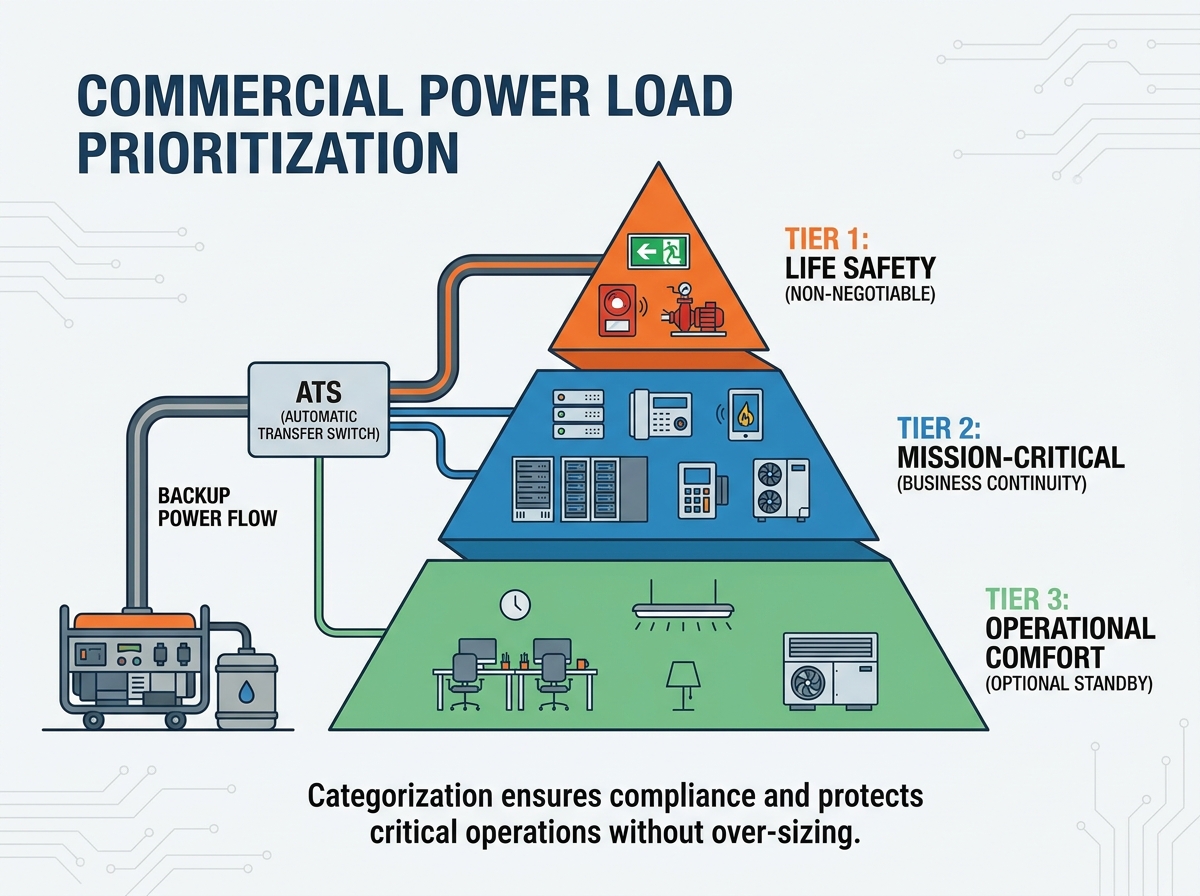
Categorization is Critical: Systems must be segmented into Life Safety (legally required), Mission-Critical (revenue-protecting), and Comfort (optional) tiers.
Mind the Gap: Generators have a mechanical startup delay; sensitive IT and data systems require a UPS (Uninterruptible Power Supply) bridge.
Avoid Sizing Traps: Specifying emergency power for commercial building systems requires calculating peak inrush currents, not just standard running watts.
Compliance Drives Baseline: NEC and NFPA codes dictate strict minimums for life safety backup that override operational preferences.
Segmenting your loads guarantees efficient power distribution. We recommend dividing systems into three distinct tiers. This approach optimizes your infrastructure.
Facility managers must prioritize legally mandated systems. The National Electrical Code (NEC) Article 700 dictates emergency systems. The National Fire Protection Association (NFPA) 110 provides standards for emergency power supplies. These requirements are legally binding. You cannot bypass them to save money. Code mandates powering fire suppression pumps and emergency egress lighting. It includes fire alarms and designated emergency elevators. Failing to support these systems invites severe legal liabilities. It also endangers human lives during catastrophic events.
This tier protects your primary revenue streams. You must support systems tied directly to business survival. Data preservation requires immediate continuous power. Inventory survival relies on stable environments. Examples include server rooms and access control security systems. You should also power specialized HVAC for telecom closets. Commercial refrigeration systems fall into this tier for grocery or pharmaceutical facilities. Properly sizing emergency power for commercial building systems demands careful calculation here.
These represent non-essential loads. The NEC categorizes them under Article 702 for Optional Standby Systems. Examples include general building HVAC and workstation outlets. Non-emergency lighting also belongs here. Providing power to Tier 3 heavily inflates your equipment footprint. This choice drives up capital expenditures significantly. You should carefully weigh the necessity of operational comfort. Most facilities shed these loads during grid failures.
Calculating capacity goes beyond simply adding up running wattages. You must account for dynamic electrical behaviors and inrush currents.
Motor-driven systems behave differently when starting. Elevators and large HVAC compressors require massive initial power surges. This temporary demand is called Locked Rotor Amps (LRA). It often triples the continuous running wattage. A commercial backup power generator must handle these temporary spikes. If it fails, the engine stalls.
Skeptics sometimes suggest cutting corners to save money. This leads directly to undersizing. Undersized units cause tripped breakers and severe voltage dips. They often inflict permanent hardware damage. Oversizing presents equally serious mechanical risks. Diesel engines running on light loads experience "wet stacking." This condition causes unburned fuel to accumulate in the exhaust. It happens because the engine fails to reach optimal combustion temperatures. Wet stacking drastically reduces unit lifespan. It also frequently voids manufacturer warranties.
You should calculate your current peak load accurately. Next, add a conservative 20 to 25 percent buffer. This margin accommodates future facility expansion. You might add electric vehicle chargers or new servers later. Never estimate power needs based on raw square footage. Precise load calculation prevents costly premature replacements.
Sizing Error | Mechanical Impact | Long-Term Consequence |
|---|---|---|
Undersizing Equipment | Tripped breakers, voltage drops | Permanent hardware damage, network resets |
Oversizing Equipment | Low combustion temperatures | Wet stacking, voided warranties |
No mechanical engine provides instantaneous electricity. Understanding this transition delay remains crucial for facility resilience.
Every heavy engine requires time to crank and stabilize. There is an inherent 10 to 15-second mechanical delay. This brief gap can devastate sensitive electronics. Servers crash and medical monitors shut down instantly.
You need a reliable bridge during this startup phase. UPS battery systems serve this exact purpose. They provide seamless electricity to zero-tolerance systems. Data centers and healthcare facilities rely heavily on them. Online double-conversion UPS units offer the best protection. They prevent data corruption and hardware crashes. They carry the load seamlessly while the engine spools up.
The ATS acts as the central brain of your emergency setup. It monitors utility voltage continuously. Upon detecting an outage, it safely decouples your building from the utility grid. Then, it signals the engine to start. Modern ATS units manage prioritized load shedding. They introduce heavy mechanical loads sequentially. This prevents the initial surge from stalling the alternator. Smart distribution keeps your critical operations stable.
Choosing the right fuel requires balancing energy density against maintenance demands. You must also satisfy strict local environmental regulations.
Your fuel choice dictates response times and ongoing maintenance protocols.
Diesel Systems: They offer high energy density and rapid response times. Life safety codes often mandate onsite diesel fuel storage. However, diesel degrades over time. It requires routine fuel polishing and biocide treatments to prevent engine failure.
Natural Gas Systems: They provide a continuous fuel supply from municipal pipelines. They also produce significantly lower emissions. Unfortunately, they carry unique deployment risks. Underground pipelines remain vulnerable to localized disruptions. Major seismic events or severe winter storms can sever this supply.
Municipalities strictly regulate standby power equipment. You must verify local EPA emissions tiers before buying any hardware. Noise ordinances also dictate specific placement requirements. Many jurisdictions require custom sound-attenuated enclosures. These expensive enclosures dampen engine noise for nearby residential zones. Ignoring these codes delays deployment and incurs heavy fines.
Buying premium hardware does not guarantee emergency readiness. Regular proactive upkeep is strictly required.
Facility leaders often assume their equipment remains ready indefinitely. This represents a highly dangerous myth. The primary cause of failure during an outage is simple deferred maintenance. Dead starter batteries cause the vast majority of non-starts. Clogged fuel filters rank a close second. You must schedule proactive visual and mechanical inspections.
Many managers rely on weekly "no-load" exercises. These brief runs remain insufficient for large engines. They do not bring the system to full operating temperature. You must perform annual load bank testing. This rigorous process artificially simulates full facility demand. It clears harmful carbon deposits from the exhaust. It also verifies actual performance against the original nameplate capacity. We recommend strictly following NFPA 110 maintenance schedules. Include fluid sampling for oil and coolant.
Sourcing reliable equipment involves more than browsing spec sheets. It requires precise engineering and thorough vendor vetting.
Do not rely solely on historical utility bills. Monthly bills only show average consumption. They never reveal peak inrush demands. We strongly recommend a physical load audit. A certified electrical engineer should evaluate your infrastructure onsite. They will map your single-line diagrams accurately. This process pinpoints your most critical distribution pathways.
You must evaluate whether a vendor provides complete solutions or hardware-only delivery. Consider their full scope of work carefully.
Do they handle concrete pad pouring and structural engineering?
Are they licensed for complex ATS wiring integration?
Do they manage municipal permitting and environmental compliance?
Do they provide ongoing preventative maintenance contracts?
Dropping a heavy unit on a loading dock is inadequate. A competent partner manages the entire integration process from start to finish. If you need a comprehensive commercial backup power generator consultation, specialized engineers can guide your site audit.
The effectiveness of your emergency infrastructure depends on rigorous planning. It requires strict load prioritization across your entire building. Correct ATS and UPS integration prevents catastrophic data loss. You must maintain strict adherence to fire and maintenance codes. Simply buying the biggest unit available often causes serious mechanical problems.
Audit your loads to separate life safety from optional comfort systems.
Account for motor inrush currents to avoid undersizing or oversizing traps.
Implement robust UPS systems to bridge the critical engine startup delay.
Commit to annual load bank testing to ensure completely reliable activation.
Encourage your decision-makers to act proactively. Schedule a professional load-profiling assessment immediately. Contact an enterprise power specialist to audit your current electrical single-line diagrams today.
A: Local fire codes and NFPA 110 dictate legal minimums. You must power emergency egress lighting, fire pumps, and fire alarm systems. Certain elevators designated for emergency response also require immediate backup power. These systems ensure safe evacuation during catastrophic events.
A: Yes, it is technically possible. However, full-facility backup is rarely cost-effective. Powering optional comfort loads requires massive equipment. It inflates capital expenses and complicates maintenance. Prioritizing critical loads makes far more financial and operational sense.
A: There is a mechanical delay of 10 to 15 seconds. Engines need time to crank and reach operating speed. You must use an Uninterruptible Power Supply (UPS) to bridge this gap. The UPS ensures instant continuity for zero-tolerance electronic systems.
A: Oversized diesel units suffer from wet stacking. Light loads prevent the engine from reaching high combustion temperatures. Unburned fuel and carbon build up in the exhaust system. This decreases efficiency, increases long-term maintenance costs, and often voids manufacturer warranties.