Author: Site Editor Publish Time: 2026-07-25 Origin: Site
Selecting a commercial standby power system is a high-stakes capital decision. A failure here directly impacts life safety, data integrity, and operational revenue. Facility managers face immense pressure during these critical moments. Power interruptions cause severe financial damage in minutes.
Generic power generation approaches no longer suffice in modern industries. We must shift our focus toward facility-specific load management, active risk mitigation, and strict regulatory compliance. Understanding these variables ensures continuous operation during unexpected grid failures. Relying on basic uptime assumptions leaves large facilities vulnerable to catastrophic losses.
This guide serves as an evidence-based framework for facility leaders. You will learn how to evaluate, size, and select the exact backup power architecture your industrial site requires. We cover everything from load priorities to implementation realities. You can use these insights to navigate supply chain delays, evaluate vendors, and build a truly resilient power infrastructure.
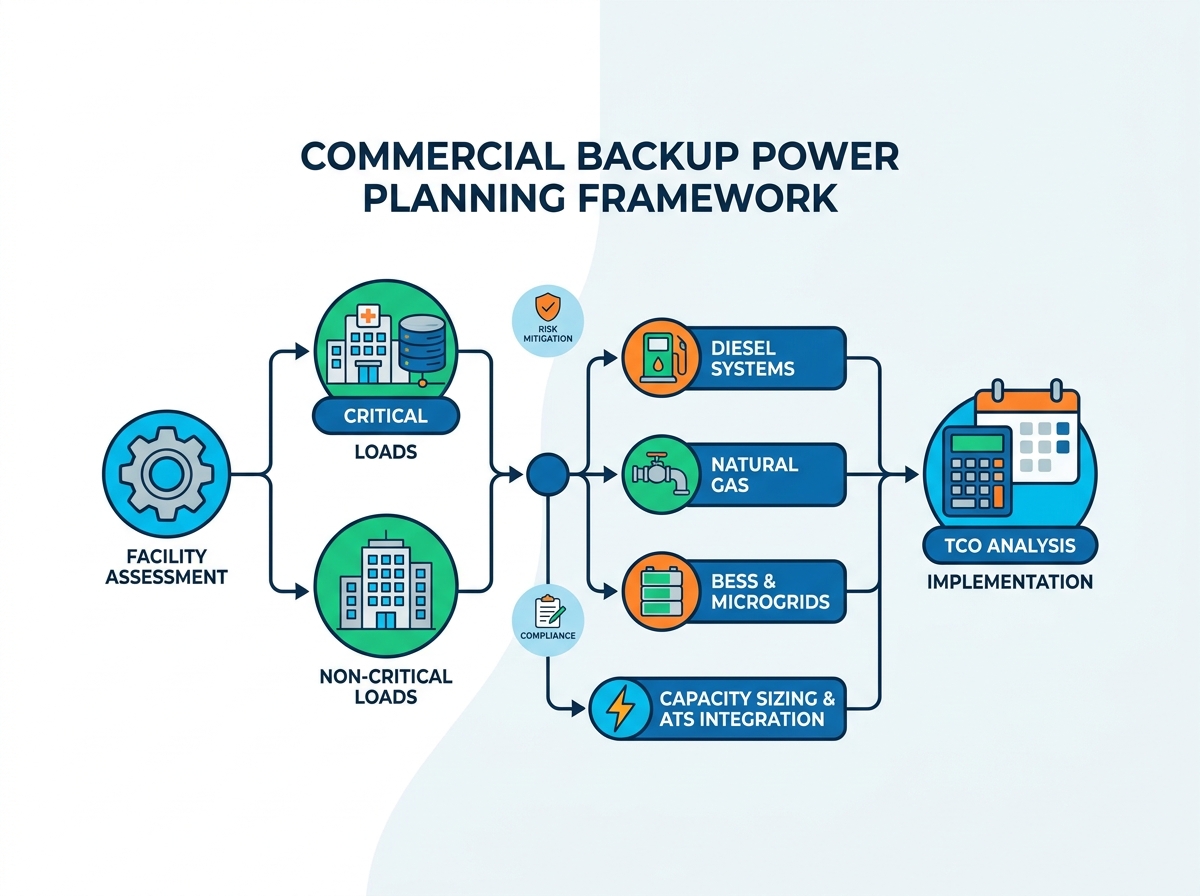
Evaluating backup power requires shifting from "generator size" to categorizing critical versus non-critical facility loads.
The choice between diesel, natural gas, and battery energy storage systems (BESS) hinges on fuel availability, emissions regulations, and operational runtime requirements.
Total Cost of Ownership (TCO) extends far beyond the initial CapEx, heavily weighting preventative maintenance, testing protocols, and fuel management over a 20-30 year lifespan.
Successful deployment demands factoring in site preparation, permitting delays, and long lead times for automatic transfer switches (ATS) and switchgear.
A successful power strategy begins by defining exact resilience requirements. You must understand your facility's unique operational constraints. A generic approach guarantees overspending or dangerous under-sizing.
You need to quantify the hourly cost of downtime for your specific facility. Different industries face unique financial penalties during outages. In heavy manufacturing, a sudden loss of power ruins production batches. This causes massive yield loss. Staff must spend hours clearing jammed machinery. In data centers, operators face severe Service Level Agreement (SLA) penalties. A ten-minute outage can cost millions in broken contracts. Cold storage facilities face rapid inventory spoilage. You must calculate these hourly risks to justify your capital expenditure.
Modern electrical planning requires strict categorization of facility loads. You must distinguish between legally required emergency systems and optional standby power. Life safety systems demand immediate power restoration. These include egress lighting, fire pumps, and smoke evacuation fans. Building codes mandate these priorities. Conversely, optional standby systems include general HVAC and non-critical production lines. Categorizing these loads establishes a realistic baseline for backup power for commercial buildings. You avoid sizing the system to support the entire building unnecessarily.
Simple uptime percentage is a flawed metric. You must measure switchover latency. Standard facilities tolerate a ten-second delay. Highly sensitive operations require millisecond latency. Regulatory compliance serves as another non-negotiable metric. Systems must meet National Fire Protection Association (NFPA) 110 readiness standards. You must prove your equipment can start and assume full load within precise timeframes. Meeting these standards ensures legal compliance and genuine operational readiness.
You must select a technology profile matching your operational environment. Every system carries specific physical and regulatory trade-offs. We evaluate three primary architectures below.
Diesel systems remain the industry standard for heavy industrial applications. They offer exceptionally high energy density. They respond rapidly to transient load changes. Industrial facilities rely on diesel units to start large motors seamlessly.
However, diesel ownership carries significant operational burdens. The fuel degrades over time. You must implement strict fuel polishing schedules to remove water and microbial growth. Degraded fuel ruins injectors and halts operation during emergencies. Additionally, you face increasingly stringent local emissions regulations. The Environmental Protection Agency (EPA) mandates Tier 4 compliance in many jurisdictions. This requires complex exhaust aftertreatment systems. These components add cost and require specialized maintenance.
Common Mistake: Facility managers often ignore diesel fuel polishing. Stored diesel degrades after six months. Attempting to run a generator on stale fuel clogs filters instantly, causing the engine to fail when you need it most.
Natural gas units are ideal for facilities requiring extended runtimes. They eliminate the burden of on-site fuel storage. You draw fuel directly from municipal pipelines. This allows a commercial backup power generator to run continuously for days during prolonged grid outages.
These systems present specific risks. They generally have lower power density compared to diesel. Their transient response to sudden load spikes is slower. Furthermore, natural gas lines remain vulnerable to catastrophic regional disruptions. Extreme freezing weather can drop pipeline pressure, starving the generator of fuel. Bi-fuel systems attempt to bridge this gap. They start on diesel and transition to natural gas, offering a balanced risk profile.
BESS provides a seamless, instantaneous power transition. You experience zero blink during a grid failure. Facilities often pair batteries with traditional generators. This hybrid approach allows the battery to carry the facility while the generator spins up. The combination maximizes reliability.
The primary trade-off involves high initial capital expenditure. Batteries also suffer from limited duration. A standard BESS provides two to four hours of runtime at full load. Once depleted, the system requires grid power or a generator to recharge. Furthermore, lithium-ion architectures demand specific climate-controlled footprints. They require advanced fire suppression systems to mitigate thermal runaway risks.
Generator Technology Comparison
System Type | Primary Advantage | Key Limitation | Typical Runtime |
|---|---|---|---|
Diesel | High energy density & rapid response | Fuel degradation & strict emissions laws | Days (depends on tank size) |
Natural Gas | Continuous municipal fuel supply | Vulnerable to pipeline pressure drops | Indefinite (until pipeline fails) |
BESS | Zero-millisecond switchover latency | High CapEx & limited duration capacity | 2 to 4 hours |
Proper integration requires rigorous engineering. Sizing errors compound over time. They lead to frequent trips, equipment damage, or complete failure during an outage.
Standard "peak load" sizing is fundamentally flawed. You cannot simply sum the data plate ratings of every machine in the building. You must perform a step-load analysis. Industrial motors and heavy HVAC compressors require massive inrush currents to start. A motor might draw six times its running current for a few seconds. If multiple heavy loads start simultaneously, they will stall the generator. You must sequence these loads. Step-load analysis programs the system to start critical lighting first, followed by HVAC units, and finally heavy machinery. This prevents voltage dips and frequency instability.
The ATS dictates how your equipment communicates with the existing electrical infrastructure. It acts as the brain of the emergency system. You must choose between open-transition and closed-transition switches.
Open-Transition: Operates on a "break-before-make" logic. The switch disconnects from the dead grid before connecting to the generator. The facility experiences a brief moment of darkness. This is simple, safe, and cost-effective.
Closed-Transition: Operates on a "make-before-break" logic. It briefly synchronizes the generator with the returning grid power. The facility experiences zero interruption when transitioning back to normal power. This requires complex utility approvals and specialized relays.
Physical integration often dictates technology choices. You must factor in physical space requirements. Heavy units demand thick concrete pads. Roof-mounted systems require structural engineering reviews to ensure the building can support the dynamic load and vibration. Acoustic constraints are equally critical. Municipal noise ordinances strictly limit decibel output at the property line. You will likely need custom acoustic enclosures. These enclosures increase the equipment footprint significantly. You must plan for adequate airflow to prevent the engine from overheating inside a sound-attenuating box.
Facilities grow. Electrical loads increase. You should structure parallel generator configurations to accommodate future expansion. Installing two smaller units in parallel is often smarter than buying one massive unit. This modular approach allows for capacity expansion as the facility grows. You avoid the massive cost of ripping out and replacing an undersized unit later. Parallel systems also offer redundancy. If one engine fails, the second engine can carry the life safety loads.
Procuring the equipment is only the first hurdle. The deployment phase introduces immense logistical challenges. You must proactively manage supply chains, regulatory bodies, and testing protocols.
Industrial power infrastructure suffers from prolonged lead times. You must transparently plan for these delays. Custom industrial enclosures and specialized switchgear often require six to twelve months for delivery. You cannot rush the manufacturing of high-voltage components. Project managers must align construction schedules around these delivery dates. Failing to order the ATS early will stall the entire building commissioning process.
Navigating local bureaucracies requires patience and precision. You must secure environmental impact studies before procurement. Local zoning laws restrict where you can place external fuel tanks. Fuel storage permits demand rigorous secondary containment plans to prevent soil contamination. Some municipalities require air quality board approvals before you can run the engine for testing. You must secure all permits before breaking ground.
Best Practice: Engage a local permitting expediter early in the design phase. They understand the specific municipal codes and can highlight potential zoning conflicts before you purchase non-compliant equipment.
Never assume a newly installed system will perform perfectly. You must demand rigorous initial stress-testing. Commissioning agents use external load banks to simulate real-world failure conditions.
Resistive Testing: Verifies the engine can produce its full rated kW capacity without overheating.
Reactive Testing: Adds simulated motor loads (kVAR) to verify the alternator can handle sudden voltage fluctuations.
This stress test forces the engine to run at 100% capacity for several hours. It seats the piston rings and identifies manufacturing defects before you sign the final acceptance documents.
Choosing the right manufacturing partner ensures operational viability over the equipment's lifespan. You are entering a twenty-year marriage with the service provider. The initial purchase price represents a fraction of the total expenditure.
You must analyze long-term operational expenditures alongside the initial capital cost. Preventative maintenance contracts require substantial annual budgets. You must account for frequent oil changes, coolant flushes, and starter battery replacements. Fuel lifecycle management also drains operational budgets. Diesel units require annual fuel polishing and bi-annual load banking. You must weigh these ongoing maintenance burdens against the upfront cost of the machinery.
Vendor capabilities matter more than brand names. You must evaluate their Service Level Agreements rigorously. Assess their guaranteed emergency response times. A four-hour response guarantee is useless if their nearest technician is three states away. Investigate their local parts availability. Ensure they stock critical components like voltage regulators and fuel pumps locally. Furthermore, demand 24/7 remote monitoring offerings. A reliable vendor will monitor your system via telemetry and dispatch a technician before you even realize a fault occurred.
Understanding warranty documentation prevents expensive surprises. You must differentiate between comprehensive, standalone, and extended warranties. Some warranties only cover parts, leaving you responsible for massive labor and travel costs. You must identify exactly what actions void the agreement. Missing a scheduled maintenance interval or failing to keep accurate service logs will instantly void most manufacturer warranties. A commercial backup power generator demands strict adherence to the factory maintenance schedule. Your technicians must document every filter change and fluid inspection.
A commercial power system is a highly integrated infrastructure project. It is never a plug-and-play appliance. You must align your mechanical, electrical, and operational teams to guarantee success. Overlooking footprint constraints, ignoring step-load inrush currents, or neglecting municipal emissions laws will lead to project failure. You must build a strategy prioritizing resilience over simple compliance.
Your next step requires decisive technical action. We strongly advise decision-makers to initiate a comprehensive power audit immediately. Schedule a site walk with a licensed electrical engineer. They will verify your true load requirements, assess spatial constraints, and map your existing switchgear. You must complete this engineering diligence before soliciting any vendor bids. Accurate data ensures you procure a system capable of defending your facility against any disruption.
A: A well-maintained unit typically lasts 20 to 30 years. Operationally, this translates to 10,000 to 30,000 running hours. This lifespan relies heavily on strict adherence to preventative maintenance schedules. You must replace hoses, belts, and batteries regularly. Routine testing ensures seals remain lubricated and prevents premature engine failure.
A: Facilities should perform weekly or monthly no-load exercise runs to verify basic functionality. Additionally, you must execute annual or semi-annual load bank testing. This pushes the engine to operating temperature, preventing wet stacking in diesel units. This routine is legally required to ensure compliance with NFPA standards.
A: It is possible for low-load facilities or short durations. However, heavy industrial operations require massive power reserves. Most large buildings employ a hybrid system. Renewables offset daily energy costs, while a mechanical generator ensures absolute long-duration reliability during extended, multi-day grid failures.
A: The term kW represents actual, working power available to do work. The term kVA represents apparent power within the system. The difference involves the power factor of your commercial equipment. Industrial motors introduce reactive loads. You must size generators considering kVA to accommodate these inefficiencies safely.