Author: Site Editor Publish Time: 2026-07-22 Origin: Site
A commercial backup power generator acts as a critical facility safeguard against an increasingly unpredictable electrical grid. It stands as a high-capital asset yielding zero return until the exact moment a severe grid failure occurs. When a sudden power outage strikes, absolute equipment reliability immediately dictates total business continuity. Sadly, most generator failures during a power loss do not result from catastrophic mechanical flaws. Instead, they trace directly back to deferred routine maintenance and overlooked operational checks.
Dead starter batteries, degraded diesel fuel, and unaddressed coolant leaks cause the vast majority of emergency system failures. We designed this article to solve this specific operational vulnerability. You will discover a robust, facility-level maintenance framework tailored for complex emergency power systems. Read on to explore clear decision-making criteria, standardized inspection routines, and professional capacity validation methods. This comprehensive guide ensures your power infrastructure never fails when you need it most.
Standardized, time-based maintenance schedules (daily visual to annual load testing) are critical for mitigating the risk of standby power failure.
Fuel degradation and battery depletion account for the vast majority of commercial generator startup failures.
Facility managers must delineate between routine in-house operational checks and specialized maintenance requiring certified technicians.
Selecting a maintenance partner requires evaluating SLA response times, compliance reporting capabilities, and technician certifications.
Many facility leaders mistakenly view emergency system upkeep as an optional or flexible expense. This passive mindset creates immense operational risk. You must actively contrast the highly predictable cost of scheduled operations and maintenance against the exponential costs of catastrophic facility downtime. A sudden power loss causes immediate inventory spoilage, severe data corruption, and completely halted production lines. A strictly maintained commercial backup power generator eliminates these devastating financial losses entirely. Routine preventive care acts as a definitive insurance policy for your overarching revenue streams.
Beyond immediate financial preservation, regulatory compliance continuously drives proactive maintenance protocols. Facilities must adhere to rigorous governmental and industry safety standards. The National Fire Protection Association outlines specific requirements in NFPA 110 for emergency power supply systems. Local fire codes typically mandate similar stringent testing protocols. Failing to document routine tests exposes your organization to severe legal liability. If an emergency system fails during a fire or a critical facility evacuation, an undocumented maintenance history instantly becomes a massive legal vulnerability.
Furthermore, proactive care explicitly mitigates the inherent start-up risks associated with standby equipment. Standby generators sit completely idle for extended periods. This prolonged inactivity makes them highly susceptible to harsh environmental degradation. Temperature fluctuations constantly cause condensation inside metal fuel tanks. Inactive engines suffer from settling lubrication fluids, drying rubber seals, and destructive pest intrusions. Routine operation and structured servicing actively reverse these degrading effects, ensuring the engine remains primed for instant mechanical engagement.
Effective facility maintenance requires rigorous, verifiable standard operating procedures rather than generic operational advice. You must emphasize precise tracking and continuous documentation across all internal departments. A structured schedule prevents minor anomalies from developing into catastrophic engine failures.
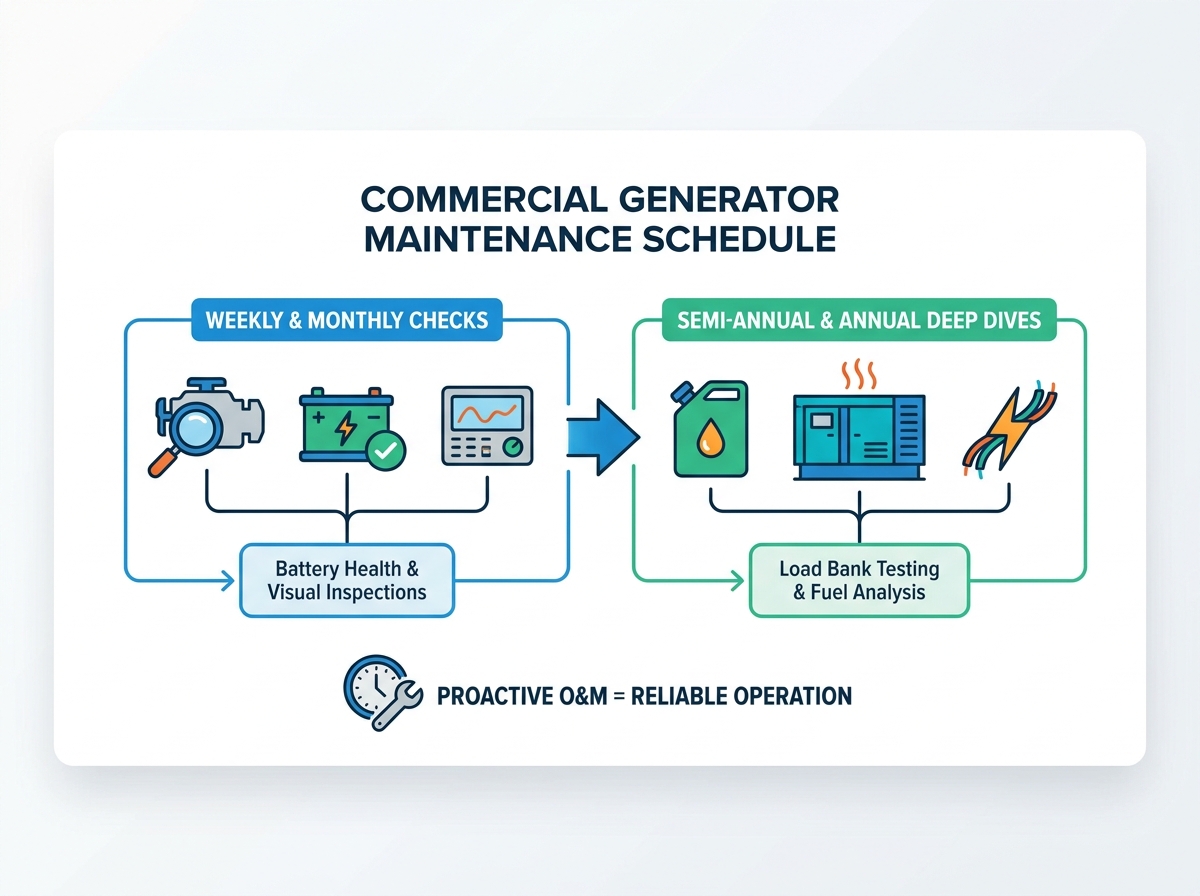
The following preventive care schedule highlights the specific frequency and scope of necessary system inspections.
Inspection Category | Service Frequency | Primary Operational Focus Areas |
|---|---|---|
Visual & Fluid Checks | Weekly | Engine oil levels, coolant leaks, primary fuel lines |
Battery System Health | Monthly | Terminal corrosion, specific gravity, trickle charger output |
Fuel Quality Management | Semi-Annually | Microbial growth, water ingress, sediment buildup |
Full System Deep-Dive | Annually | Drive belts, ATS testing, comprehensive alternator output |
Basic visual and fluid inspections form your absolute first line of defense against unexpected outages. Technicians must check engine oil and radiator coolant levels weekly. They should inspect all rubber fuel lines for tiny leaks or surface condensation. Engine oil actively loses viscosity over time, and acidic coolant slowly eats away at internal cylinder liners. Catching a weeping hose or a minor fluid drop early prevents highly dangerous operating conditions during a real crisis.
Battery system health demands strict monthly attention from your maintenance staff. You must inspect lead-acid battery terminals for destructive acid corrosion. Technicians should carefully check the specific gravity of individual battery cells using a hydrometer. Verifying continuous trickle charger operation remains the single most crucial step in this process. A failed battery charger represents the number one cause of startup failure worldwide. If the charger dies, the generator simply cannot crank the massive engine block.
Finally, you must rigorously evaluate the main control panel and the engine block heaters. Always verify the digital control unit remains firmly set to the "Auto" position. Clear any lingering alarm logs to ensure highly accurate future system warnings. Confirm engine block heaters function correctly by physically checking their operating temperature. Proper block temperatures ensure optimal starting conditions and prevent thick, sluggish oil during freezing winter weather.
Fuel quality management requires specialized analytical attention at least twice a year. Technicians must test stored bulk diesel for dangerous microbial growth. They should check the tank bottom for internal water ingress and accumulated heavy sediment. Microbes thrive at the precise intersection of water and diesel fuel. If severe contamination exists, you must assess the immediate need for professional fuel polishing. Clean, polished fuel guarantees smooth combustion and prevents entirely clogged fuel injectors.
Cooling and exhaust systems also require rigorous annual checks to maintain optimal thermal regulation. Inspect all serpentine drive belts for fraying, cracking, or severe tension loss. Examine external radiator hoses for dangerous dry rot. Technicians must check heavy exhaust manifolds for visible signs of wet stacking. Wet stacking indicates thick, unburned fuel buildup in the exhaust system, severely limiting output performance.
Electrical and alternator checks complete the vital annual maintenance cycle. Inspectors must torque and tighten all high-voltage wiring connections. They will test automatic transfer switches to verify seamless electrical grid transition. Verifying precise alternator output ensures the unit actually generates the required stable voltage. An untested, unverified commercial backup power generator merely offers a false sense of facility security.
Routine visual maintenance alone cannot guarantee full-load performance during a massive facility outage. You need comprehensive load bank testing to truly validate system capacity.
Load bank testing involves running the massive generator at its full artificial electrical load. Specialized external equipment applies a simulated, scaled electrical draw directly to the power system. Technicians typically ramp up this resistance in sequential steps to observe governor stability. Routine "no-load" weekly running remains wholly insufficient for diesel engines. Running a massive diesel engine without a proper heavy load actually causes progressive internal mechanical damage.
Diesel engines inherently need intense internal heat to perform correctly and efficiently. Running a commercial diesel unit under full load actively raises internal cylinder temperatures to their designed peak. This intense heat effectively burns off accumulated internal carbon deposits. It actively prevents and cures the dangerous condition known as wet stacking. Eliminating this thick, unburned fuel buildup immediately restores engine efficiency and strictly prevents disastrous exhaust fires.
Simply completing the load test does not guarantee future reliability. You must completely understand how to interpret load test data. Certified technicians carefully monitor voltage drops, frequency stability, and critical cooling performance under maximum applied stress. This recorded data verifies the heavy equipment can actually handle your facility's peak emergency draw. It ensures the standby system successfully supports massive sudden surge loads, rather than just your baseline daily operations.
Facility leaders frequently struggle to divide critical maintenance responsibilities efficiently. A distinct, documented division between internal staff and external electrical experts maximizes facility safety and strictly protects your maintenance budget.
You must clearly define exactly what your facility teams should handle. Internal staff generally excel at routine administrative tasks and high-frequency visual inspections. Assign the following tasks directly to internal teams:
Logging daily and weekly visual operational parameters.
Completing basic fluid level checks and basic top-offs.
Clearing surrounding physical debris from external weatherproof enclosures.
Monitoring control panel warning lights and reporting digital fault codes.
Conversely, you must identify when specialized tooling and liability transfer become strictly necessary. Do not allow untrained internal staff to attempt complex electrical repairs. Professional external intervention remains absolutely mandatory for specific high-risk tasks. These critical interventions include high-voltage electrical testing, hazardous fluid disposal, automated transfer switch calibration, and invasive engine block repairs.
A fully customized DIY approach carries massive hidden operational costs. Incorrect maintenance practices easily void expensive manufacturer warranties. Furthermore, local fire marshal audits strictly require certified, timestamped inspection records. An amateur internal maintenance log creates severe compliance documentation gaps. If a catastrophic emergency occurs, undocumented maintenance places full legal and financial liability directly on facility management.
Choosing the right external service vendor explicitly dictates your ultimate uptime reliability. Evaluate potential service partners using these stringent, standardized criteria.
First, examine their Service Level Agreement closely. Ask for guaranteed on-site response times during massive regional weather events. When a massive hurricane or blizzard hits, demand for certified technicians spikes dramatically. You desperately need a dedicated partner who prioritizes your contract over random ad-hoc calls.
Second, never hire uncertified independent contractors. Stress the absolute importance of utilizing technicians certified by recognized industry bodies. Look for direct affiliations like the Electrical Generating Systems Association. Certified experts meticulously follow rigorous, standardized testing protocols that protect your expensive equipment.
Third, demand comprehensive digital reporting. Basic paper invoices remain entirely obsolete in modern facility management. Ensure the vendor provides digital, audit-ready compliance tracking dashboards. They should use robust platforms similar to industry best practices. Transparent digital documentation instantly proves compliance to any visiting fire inspector.
Finally, assess the local provider's exact physical inventory. Global supply chain delays will instantly ruin your emergency readiness. Verify they stock critical wear parts precisely for your specific engine brand. They should immediately have proper belts, specialized air filters, and precise engine sensors available in their local warehouse. To ensure complete operational safety, consider upgrading your infrastructure or requesting an audit for your current commercial backup power generator setup today.
A standby power system truly remains only as reliable as its last accurately documented maintenance check. Passive neglect breeds catastrophic failure, while proactive, scheduled care ensures completely uninterrupted business continuity. You cannot afford to wait for a regional blackout to discover a dead starter battery or degraded engine fuel.
Audit your current historical maintenance logs immediately against this comprehensive standard checklist.
Strictly separate basic internal visual tasks from external certified high-voltage testing requirements.
Prioritize consistent battery health and strict fuel quality to prevent the most common equipment startup failures.
Request a full baseline inspection and a rigorous load bank test from a certified external provider immediately.
A: Facilities must implement a tiered service approach. Internal staff should perform visual checks and fluid inspections weekly. You must run the engine without a load monthly to verify battery and starter function. Finally, schedule a comprehensive professional service annually, which includes load bank testing, filter replacements, and detailed electrical inspections.
A: A well-maintained commercial diesel generator typically lasts between 10,000 and 30,000 operating hours. In terms of chronological age, this translates to roughly 20 to 30 years of reliable standby service. However, achieving this maximum lifespan remains strictly contingent on rigorous adherence to standardized maintenance schedules and regular fluid replacements.
A: Maintenance costs vary significantly based on multiple operational factors. The exact kilowatt size of your unit, your geographic location, and your chosen fuel type heavily influence pricing. Additionally, specialized contract tiers featuring faster guaranteed emergency response times will increase the baseline cost. Treat this expense as vital infrastructure insurance.
A: You should not perform load bank testing internally. This specific procedure requires highly specialized resistive testing equipment. It also presents extreme high-voltage safety hazards to untrained personnel. We strongly recommend hiring certified external professionals to execute the test, accurately interpret the thermal data, and ensure strict regulatory safety compliance.