Author: Site Editor Publish Time: 2026-07-28 Origin: Site
Facility managers often face a difficult dilemma when securing reliable energy for large properties. Traditionally, diesel engines served as the default choice to keep critical operations running during grid failures. However, strict environmental regulations and complex fuel-storage logistics now force a major industry shift toward cleaner alternatives. Can you rely on a commercial backup power generator fueled by natural gas? Yes, these systems offer a highly viable solution for modern facilities. They work exceptionally well for businesses prioritizing indefinite runtime and strict emissions compliance over raw, instantaneous power density.
This article provides an objective breakdown of operational realities, infrastructure requirements, and deployment constraints. We will help stakeholders determine if natural gas fits their specific facility load profile and physical footprint. You will learn about key sizing criteria, integration risks, and how to accurately evaluate utility pipeline reliability in your specific region.
Natural gas units eliminate the need for on-site fuel storage and fuel degradation management, relying instead on municipal utility lines.
They are highly favored for facilities with strict ESG mandates or locations with rigorous local emission and noise ordinances.
While offering virtually infinite runtime during standard grid outages, they carry a distinct risk profile dependent on local pipeline resilience (e.g., vulnerability during earthquakes or severe freezes).
Correct sizing and utility pressure verification are non-negotiable prerequisites before selecting a natural gas system.
Diesel systems require constant logistical oversight. You must secure ongoing fuel delivery contracts. Facility teams must schedule routine drop-offs. Tank levels require manual or digital monitoring. Furthermore, diesel fuel degrades over time. Moisture inevitably builds up inside storage tanks. This moisture causes microbial growth and fuel spoilage. Consequently, maintenance teams must perform regular fuel polishing to prevent engine clogs. Natural gas bypasses these headaches entirely. The fuel flows directly from municipal pipelines into the combustion chamber. You never worry about on-site spoilage. You also eliminate the risk of physical fuel theft.
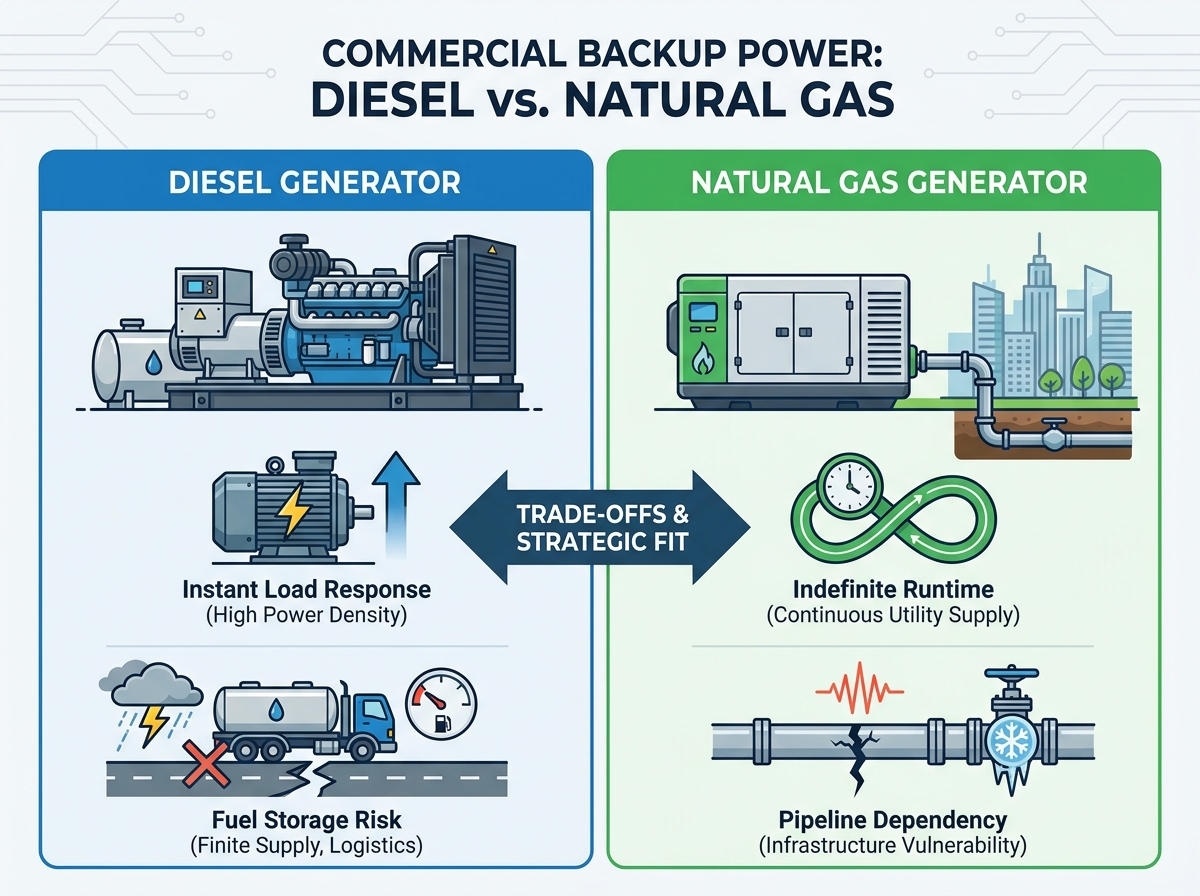
Grid failures can last for days after severe storms. Diesel tanks usually hold only 24 to 48 hours of fuel. After this window, you pray for a delivery truck. Natural gas provides a continuous fuel supply. Tapping directly into municipal utility lines grants nearly indefinite operation. As long as the underground gas infrastructure remains intact, the engine keeps running. This provides immense peace of mind. Facility managers can maintain operations through prolonged utility blackouts without rationing power.
Commercial buildings face increasingly strict emissions rules. Local governments monitor urban air quality closely. Natural gas burns much cleaner than liquid fossil fuels. It produces significantly fewer nitrogen oxides (NOx). It also releases almost no particulate matter into the atmosphere. This clean combustion profile heavily simplifies the permitting process. Navigating EPA compliance becomes much easier. Urban zoning laws often favor these systems over heavy polluters. Implementing natural gas backup generators for commercial buildings directly supports corporate sustainability initiatives and strict ESG mandates.
Sound pollution presents a major concern for dense commercial zones. Diesel engines create significant mechanical clatter and exhaust noise. Natural gas units operate differently. Their internal combustion process generally generates lower decibel outputs. This operational noise reduction proves critical in sensitive areas. Facilities located near residential neighborhoods benefit greatly. Healthcare campuses also require quiet environments for patient recovery. Lower acoustic signatures make natural gas a highly attractive option.
Industrial equipment requires massive starting current. HVAC compressors create heavy inrush loads when they activate. Diesel engines traditionally handle these sudden load spikes effortlessly. Their high torque output provides excellent instantaneous load response. Natural gas engines respond slightly slower due to basic fuel induction physics. However, manufacturers now use advanced engine management systems. Software controls air-fuel mixtures instantly to optimize torque. This technology effectively mitigates response delays. Still, you must acknowledge footprint realities. Natural gas engines require slightly larger physical engine blocks to match equivalent diesel power density.
Every emergency system carries inherent risk. You simply choose which vulnerability you accept. Diesel systems fail if delivery trucks cannot reach your facility. Regional disasters often wash out roads or block highways. Natural gas eliminates this delivery dependency. However, it introduces a completely new risk factor. It relies entirely on the local utility pipeline. Earthquakes can rupture underground mains. Extreme systemic freezes can disrupt distant wellheads. If utility lines lose pressure, your system stops functioning immediately. We refer to this as the vulnerability swap.
Evaluation Metric | Diesel Engines | Natural Gas Engines |
|---|---|---|
Load Response | Excellent for sudden, heavy inductive load spikes. | Good, but relies on advanced software to handle inrush current. |
Fuel Logistics | Requires on-site storage, delivery contracts, and fuel polishing. | Requires zero on-site storage; continuous supply from grid. |
Primary Vulnerability | Impassable roads preventing fuel truck deliveries. | Pipeline pressure drops due to seismic events or deep freezes. |
Emissions Profile | High NOx and particulate matter; strict EPA permitting. | Clean burning; easily meets strict urban ESG regulations. |
You must properly categorize your electrical demands before purchasing equipment. Building codes strictly mandate power for life-safety systems. These include emergency lighting, fire pumps, and elevator controls. Optional standby loads serve a different purpose. They power regular business operations, like standard HVAC systems and office server racks. You cannot guess these requirements. You must commission a baseline electrical load study. An electrical engineer will calculate exact running wattages. They will also measure peak starting demands. This crucial step prevents dangerous equipment undersizing.
The Automatic Transfer Switch acts as the system brain. It constantly monitors municipal grid voltage. When the grid fails, the ATS detects the drop immediately. It sends a start signal directly to the generator engine. Once the alternator produces stable, clean voltage, the ATS safely transfers the commercial load. This entire process takes just seconds. You must match the ATS rating perfectly to your infrastructure. It must align with the specific phase and voltage requirements of the commercial building to prevent electrical faults.
Gas flow volume represents the most common failure point in commercial installations. Many facilities size the electrical load perfectly but forget the fuel meter. Your current gas meter might only support standard building boilers. High-capacity engines require massive fuel volume. Engineers measure this volume in Cubic Feet per Hour (CFH). You must coordinate with the local gas provider early in the feasibility stage. Verify the utility line pressure limits. Inadequate gas meter size will starve the engine and stall your entire project.
Connecting heavy equipment to city gas lines takes time. You cannot simply plug the machine in. The utility company must approve the high-capacity draw. City inspectors must review all trenching and piping plans. This bureaucratic process often delays deployment timelines. Local zoning boards might also mandate specific setback distances from property lines. You must factor these administrative delays into your project schedule.
Space is often severely limited on commercial properties. Natural gas engines require larger piston displacements to generate equivalent power. Therefore, they often need slightly larger protective enclosures than diesel units. This physical footprint directly impacts roof spatial planning. It also changes layout requirements for parking lots. You must measure setbacks, maintenance access clearances, and exhaust routing zones very carefully.
Do not believe the "zero maintenance" myth. Yes, the fuel never degrades. However, the internal combustion engine still undergoes intense thermal stress. Spark plugs wear out over time. Synthetic oil breaks down. Starter batteries lose their charge. The ATS contactors require regular cleaning and inspection. You absolutely need rigorous, scheduled commercial service contracts. Consistent maintenance guarantees the equipment starts successfully during an actual emergency.
Certain businesses benefit immensely from this technology. Data centers need uninterrupted server uptime without fuel delivery anxiety. Urban healthcare facilities face strict noise ordinances and clean air mandates. Large retail chains want automated, hands-off solutions for multiple locations. Corporate offices prioritize ESG compliance and seamless aesthetic integration. These operational profiles make excellent candidates for pipeline-fed energy systems.
Other facilities operate much differently. Heavy industrial manufacturing plants use massive inductive motor loads. Giant stamping presses require immense instantaneous torque. These harsh environments usually favor traditional diesel power density. Additionally, facilities located in high-seismic zones face unique challenges. Known pipeline fragility makes natural gas riskier in earthquake-prone areas where underground infrastructure frequently ruptures.
Conduct an operational risk assessment to compare local grid reliability versus pipeline resilience in your specific zip code.
Commission a baseline electrical load study to accurately measure both life-safety and optional standby power demands.
Verify existing utility gas pressure limits and maximum CFH capacity with your local natural gas provider.
A natural gas system is not a universal silver bullet. Instead, view it as a strategic infrastructure upgrade. It serves facilities that value continuous, clean, and automated energy. Assessing the technical demands of your site requires professional oversight. You must validate your technical assumptions before committing to a costly installation. We strongly recommend scheduling a professional site walk and load analysis. Discuss your specific facility needs with a certified distributor. Need expert guidance on your next infrastructure project? Schedule a commercial backup power generator consultation to secure your operational resilience today.
A: Yes. They can easily power large commercial HVAC units. However, the system must be appropriately sized. You must calculate the starting kVA (SkVA) rating accurately. Compressors require a massive initial inrush current. An undersized alternator will stall during this startup phase. Proper engineering ensures the engine handles this sudden spike smoothly.
A: They usually remain fully operational. The system runs continuously as long as the municipal gas supply maintains adequate pressure. Sub-zero surface temperatures rarely affect deeply buried underground pipes. However, extremely rare, systemic deep-freezes can disrupt utility supply. Wellhead freezing is the primary risk factor during unprecedented winter events.
A: Yes, in most commercial applications. Standard building meters lack sufficient volume capacity. A dedicated, high-pressure meter ensures proper fuel delivery. Without it, the engine might starve other gas appliances during an outage. Boilers and commercial kitchens could lose pressure when the alternator runs at full load.
A: Theoretically, they can run indefinitely. The continuous municipal fuel supply eliminates tank refilling completely. However, manufacturers mandate periodic shutdowns during extended outages. You typically need to power down every 100 to 200 hours. This brief pause allows technicians to check oil levels and perform basic engine maintenance safely.